How to Care for a Chanel Bag: Lambskin vs Caviar (2026)
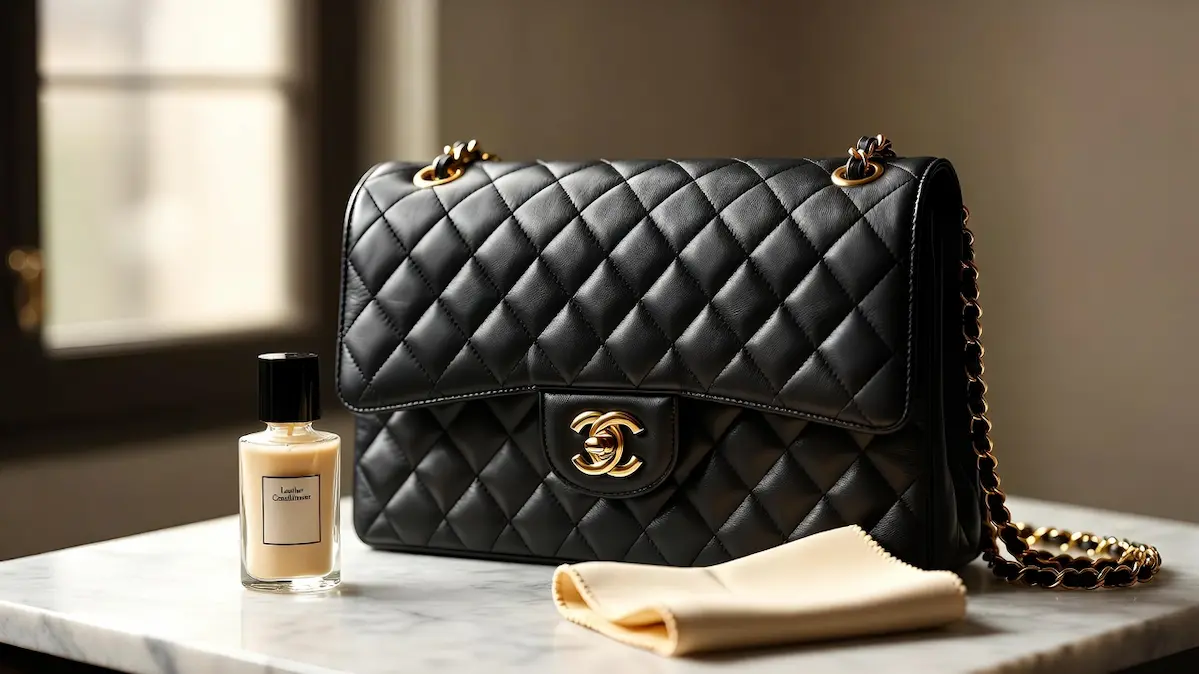
How to care for a Chanel bag depends entirely on one thing: which leather you own. Lambskin and Caviar are not interchangeable. A product that conditions Caviar correctly can permanently darken lambskin.
A cleaning technique that removes stains from Caviar grain can destroy the smooth surface of a lambskin Classic Flap. Most care guides treat them identically -- and that is the gap that causes most of the damage collectors bring to restoration specialists.
This guide covers the complete care routine for both leathers side by side, drawn from Chanel's official guidance and the collective experience of the collector community. You will find a leather comparison table, a cleaning chart by leather type, a product guide, the 7 storage mistakes that cause the most damage, and a resale value section that explains exactly how condition affects price.
Table of Contents
- Lambskin vs Caviar: Know Your Leather Before Touching Anything
- Daily and Weekly Care Routine by Leather Type
- How to Store a Chanel Bag Correctly: The Chain Technique and 4 Rules
- Hardware Care: Gold-Tone, Silver-Tone, and Ruthenium
- Best Products for Chanel Lambskin and Caviar Care
- 7 Mistakes That Are Quietly Ruining Your Chanel Bag
- How Condition Affects Chanel Resale Value: What the Numbers Show
- How Often to Rotate, Inspect, and Air Out Stored Bags
- Frequently Asked Questions
- Can I use baby wipes to clean my Chanel bag?
ℹ️ Chanel's Official Guidance (from chanel.com): Store your handbag upright in its original pouch. Wrap any chains or straps with tissue paper. Avoid prolonged exposure to sunlight, artificial light, and humidity. For lambskin specifically: "Treated as little as possible to preserve its natural suppleness." To reduce marks on lambskin surface: "Gently rub in a circular motion." Source: Christian Chanel official care instructions, chanel.com |
Lambskin vs Caviar: Know Your Leather Before Touching Anything
The most important decision in Chanel care happens before you buy any product. These two leathers behave entirely differently in response to moisture, cleaning agents, and storage conditions.
Factor | Lambskin | Caviar |
Texture | Ultra-smooth, velvet-like, luminous sheen | Pebbled grain, matte-structured, heavier |
Scratch resistance | Very low -- fingernails, keys, rough surfaces all leave marks | High -- grain texture conceals minor scuffs naturally |
Water resistance | Poor -- water spots immediately visible on most colors | Good -- fine in light rain; avoid prolonged exposure |
Quilting retention | Quilting can "deflate" if stored poorly or overfilled | Holds structure and quilting shape reliably over time |
Daily wear suitability | Special occasions and careful daily use only | Best choice for everyday use |
Care frequency | Condition every 3-4 months; clean after every use | Wipe monthly; condition once or twice a year |
Resale value stability | High when in excellent condition; drops sharply with any damage | Consistently strong -- more forgiving at resale |
Light color risk | Color transfer from denim and dark fabrics is nearly permanent | Color transfer possible but easier to address |
Chanel official guidance | "Treated as little as possible to preserve natural suppleness" | "Gently rub in circular motion to reduce marks" |
The practical takeaway: If you own a Lambskin Flap, treat it like a fine garment -- careful, minimal intervention, professional help for anything beyond surface cleaning. If you own a Caviar Boy Bag or Classic Flap, the leather is far more forgiving and responds well to routine home maintenance with the right products.
ℹ️ Why Caviar holds resale value better: The pebbled grain on Caviar leather naturally conceals minor scuffs and wear marks that would be immediately visible on smooth lambskin. A well-maintained Caviar Classic Flap purchased in 2015 and sold today in excellent condition will typically recover 90-100% of original boutique price. A lambskin bag with similar use history but visible corner wear or chain indentations may recover 60-75%. The care decisions you make now directly affect that gap. |
Daily and Weekly Care Routine by Leather Type
Most Chanel care guides either over-complicate the routine or under-specify the technique. The truth is that daily maintenance is simple -- but the technique differs meaningfully between lambskin and caviar.
Task | Lambskin Method | Caviar Method |
Daily wipe-down | Clean white microfiber cloth, light circular motions, zero pressure | Clean microfiber cloth, slightly more pressure to reach pebbled grain |
Water spot | Blot immediately with dry cloth -- never rub. Let air dry away from heat. | Blot and let dry. Caviar is more forgiving -- most light spots disappear when dry. |
Surface stain | Barely damp cloth (distilled water only), dab gently. Test hidden area first. | Damp cloth with mild leather cleaner in circular motion. Wipe clean. |
Conditioning | Apple Brand leather conditioner or Saphir Renovateur every 3-4 months | Light conditioner (Apple Brand or Bickmore) once or twice a year only |
Color transfer (denim) | Professional only -- home attempts often spread the stain | Leather cleaner + gentle circular motion. Early treatment works well. |
Corner scuff | Professional color restoration recommended. Do not attempt at home. | Light buffing with dry cloth. Grain texture often conceals minor corner scuffs naturally. |
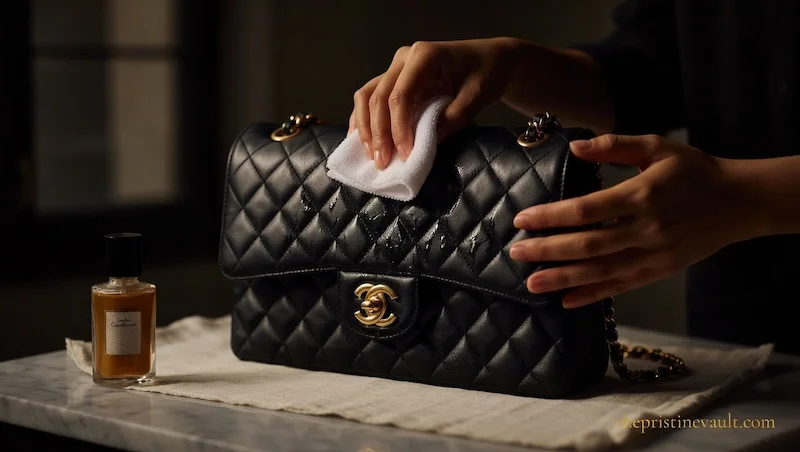
⚠️ The most important daily habit: Wipe your bag with a clean dry white microfiber cloth after every use. This removes skin oils, microscopic dust particles, and surface pollutants before they settle into the leather. On lambskin, this prevents the gradual buildup that causes surface hazing. On caviar, it prevents dirt from settling into the pebbled grain where it is much harder to remove later. Two minutes after every use prevents the need for deep cleaning sessions. |
How to Store a Chanel Bag Correctly: The Chain Technique and 4 Rules
Most Chanel bag damage happens in storage, not during wear. The chain is the most common culprit -- and most owners do not know the correct technique until after the damage has occurred.
The Chain Wrap Technique -- Do This Every Time
Chanel chains are heavy, particularly on the Classic Flap, Jumbo, and Grand Shopping Tote. When left inside the bag resting directly against lambskin, the metal weight creates indentations over days and weeks that are permanent. On caviar, the risk is lower but still present.
Remove the bag from your shoulder.
Take a sheet of acid-free tissue paper or a soft cloth sleeve (cotton or linen -- not satin, which can snag on the chain links).
Wrap the chain loosely, starting from one end. The goal is to prevent direct metal-on-leather contact, not to compress the chain.
For Classic Flap: lay the wrapped chain on top of the interior stuffing, not against the leather sides.
For Boy Bag with fixed chain: tuck the wrapped chain strap into a position where it does not rest against the front or back panel.
4 Storage Rules from Chanel's Own Guidelines
Store upright in the cotton dust bag, always. Never in the black box for long-term storage. The dust bag allows airflow; the box traps humidity.
Stuff lightly with acid-free tissue. The bag should hold its natural shape without looking bloated. Over-stuffing permanently stretches the leather and stitching.
Keep away from direct sunlight and artificial light. UV fades Chanel dyes -- particularly on lighter colors and lambskin. Interior shelf of a closed wardrobe is ideal.
Never hang by the chain or strap. The concentrated weight at the attachment point permanently warps the leather over time and stresses stitching.
Humidity Control -- Critical in Tropical Climates
For owners in humid climates (Indonesia, Singapore, Malaysia, Philippines, coastal cities), humidity is the most serious storage threat. Protein-based leather like lambskin can develop mold in as little as 4-6 weeks when stored in an environment above 65% relative humidity.
Target humidity: 45-55% relative humidity. A digital hygrometer costs under $20 and gives you real numbers instead of guesswork.
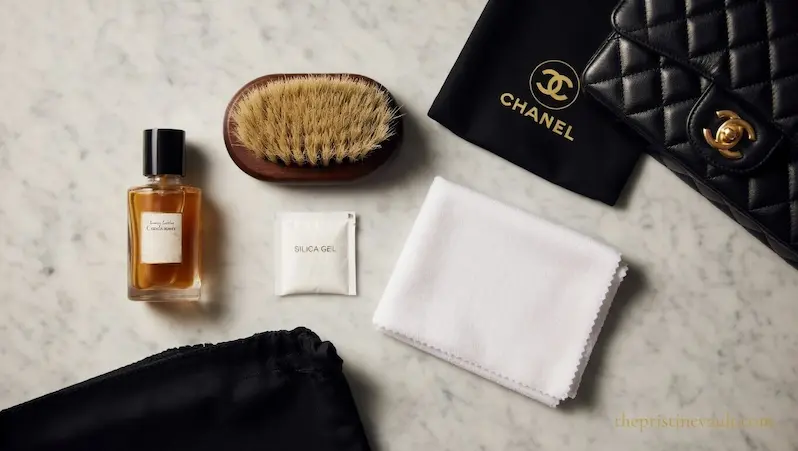
Silica gel packets: Place one or two in the dust bag or storage area. Replace every 4-6 weeks -- saturated silica gel provides no protection.
Dedicated dehumidifier: For a collection of 5 or more bags in a tropical climate, a small dehumidifier in the wardrobe or closet is a genuine investment in preservation.
Hardware Care: Gold-Tone, Silver-Tone, and Ruthenium
Chanel hardware is typically gold-tone (modern pieces use a lacquered gold-tone alloy, not plated gold), silver-tone, or the darker ruthenium finish. Each is prone to tarnishing from contact with perfume, body oils, and sweat.
Routine cleaning: Wipe hardware with a dry jewelry polishing cloth after each use. Do not use liquid cleaners near hardware -- any product that touches the surrounding leather is problematic.
Tarnish on gold-tone hardware: Light tarnish can be buffed with a dry polishing cloth. Significant tarnish requires professional attention -- do not attempt chemical cleaning at home.
Ruthenium finish: The darker hardware used on some Boy Bags and Reissues is particularly sensitive. Dry cloth only. Any chemical contact can alter the finish permanently.
Perfume exposure: This is the most common cause of hardware tarnish. Apply fragrance at least 10 minutes before picking up the bag, allowing full evaporation first.
❌ Never use silver polish, brass cleaner, or any chemical product on Chanel hardware. These products strip the lacquer coating on gold-tone hardware and permanently dull the finish. If the surrounding leather is touched in the process, the damage extends to the leather as well. Dry polishing cloth only at home -- professional service for anything more significant. |
Best Products for Chanel Lambskin and Caviar Care
The product list for Chanel bags is short by design. Less intervention is always safer than more. These are the products the collector community trusts most, and the ones to avoid entirely:
Product | Price | Safe For | Avoid On | Verdict |
Apple Brand Garde (protector) | $10-15 | Both lambskin and caviar | Patent leather | Best first application on new bags |
$10-15 | Both leather types | Hardware (keep away) | Most community-trusted conditioner | |
$24-28 | Lambskin especially | Light colors (test first) | Best for restoring dry lambskin | |
$10-18 | Caviar and calfskin | Lambskin in light colors | Best low-risk caviar conditioner | |
Baby wipes | Avoid | Do not use on either | Both -- alcohol strips leather | ❌ Never use on Chanel leather |
Saddle soap | Avoid | Equestrian use only | Both -- too aggressive | ❌ Ruins leather finish permanently |
A note on conditioning frequency: Over-conditioning is one of the most common home-care mistakes. Lambskin that feels soft and supple does not need conditioning. Condition only when the leather begins to feel slightly dry or stiff to the touch -- typically every 3-4 months for daily-use bags, twice a year for occasional-wear pieces. Caviar rarely needs conditioning more than once a year.
7 Mistakes That Are Quietly Ruining Your Chanel Bag
Every one of these mistakes appears regularly in professional restoration requests. Most are irreversible once the damage occurs.
Mistake | What It Does to Your Chanel | The Fix |
Leaving the chain directly on lambskin in storage | Metal chain weight creates permanent indentations on lambskin -- visible dents that no conditioning can remove | Wrap chains in acid-free tissue or a soft cloth sleeve before placing inside or on top of the bag |
Storing in the original black box long-term | Closed cardboard traps humidity and contains acids that transfer to leather over years -- causes mold and discoloration | Use the breathable cotton dust bag instead. Keep the box for resale presentation only. |
Over-stuffing to maintain shape | Excess stuffing stretches the leather and stitching permanently -- the bag looks bloated, not natural | Stuff lightly with acid-free tissue until the bag holds its shape naturally, not until it looks full |
Applying perfume or hairspray while wearing the bag | Alcohol in fragrance products causes permanent spotting on lambskin within seconds of contact | Always apply fragrance and hairspray before putting on the bag. Never spray near leather. |
Hanging the bag on a hook by its chain | Concentrated weight on chain-leather attachment point permanently warps the leather and stresses stitching | Store upright in dust bag on a shelf. Never hang by chain or strap. |
Using baby wipes for quick cleaning | Baby wipes contain alcohol, fragrance, and detergent -- all three strip the natural oils from Chanel leather, accelerating drying and cracking | Use only a clean dry white microfiber cloth for daily maintenance |
Storing without checking for 6+ months | Mold grows on protein-based leather in as little as 4-6 weeks in humid conditions; caught late, mold stains are often permanent | Inspect every 2-3 months. Air out for 24 hours. Recondition if leather feels dry. |
How Condition Affects Chanel Resale Value: What the Numbers Show
Chanel bag prices have increased significantly in boutiques over the past decade -- a Classic Flap that retailed at $4,900 in 2015 retails at over $12,000 today. This has pushed pre-owned values up proportionally. But condition remains the single biggest variable in secondary market pricing.
Mint condition with full set (dust bag, box, authenticity card, receipt): Typically 90-110% of current boutique retail on popular models. Some classic models command above retail.
Excellent condition, minor signs of use, full set: 75-90% of current retail.
Good condition, visible corner wear or light scratches, partial set: 55-75% of current retail.
Fair condition, visible leather damage, hardware tarnish, chain indentations: 35-55% of current retail -- and this is recoverable with professional restoration in many cases.
Real example: A 2018 Chanel Classic Flap in medium size, lambskin, black, with gold hardware. Current boutique retail equivalent: approximately $11,200. Same bag in mint condition with full set: $9,500-10,500 in secondary market. Same bag with visible chain indentations on the front panel and corner wear: $5,800-6,500. The care decisions made over five years of ownership account for a $3,000-4,000 price difference at resale.
How Often to Rotate, Inspect, and Air Out Stored Bags
Leather is an organic material. A Chanel bag stored without any handling for extended periods can be as problematic as one worn daily without care.
Every 2-3 months: Remove from dust bag. Inspect for any signs of mold (white or green spotting, musty odor), unusual dryness, or hardware tarnish. Air out for 24 hours before returning to storage.
Every 6 months: Check the interior lining. The lining is the first place mold appears in humid conditions, and it is often missed during surface-only inspections.
Once or twice a year: Wear stored bags at least once. Leather benefits from movement -- flexing during wear prevents the stiffness that develops when leather is static for extended periods.
Condition check: Apply conditioner only if the leather feels dry or looks dull. Do not condition on a schedule if the leather feels fine -- unnecessary conditioning accumulates on the surface over time.
Frequently Asked Questions
Can I use baby wipes to clean my Chanel bag?
No. Baby wipes contain alcohol, fragrance, and detergent -- all three strip the natural oils from Chanel leather. This advice circulates widely in handbag communities but causes measurable damage over time, particularly to lambskin. Use a clean dry white microfiber cloth for daily maintenance instead.
How do I remove scratches from Chanel lambskin?
Light surface marks on lambskin can often be reduced by gently rubbing the area in a circular motion with a clean fingertip -- the warmth and natural oils from clean skin help blend surface marks into the surrounding leather.
This is the technique Chanel officially recommends. For deeper scratches or corner scuffs, professional color restoration is the appropriate solution. Home attempts typically spread the mark or alter the finish.
How often should I condition my Chanel bag?
Lambskin: every 3-4 months for bags in regular use, or when the leather begins to feel dry. Caviar: once or twice a year at most. Epsom and other heavily treated leathers: rarely, if ever. Over-conditioning is a more common problem than under-conditioning -- apply product only when the leather shows actual signs of dryness, not on a fixed schedule regardless of feel.
Is it safe to use Apple Brand conditioner on Chanel?
Yes. Apple Brand leather conditioner is one of the most widely trusted products in the Chanel and luxury handbag community. It is water-based, free of silicone, and light enough for both lambskin and caviar.
Always test on a hidden area first -- the interior base of the bag or inside a pocket -- before applying to the exterior. On very pale lambskin colors, any conditioner can cause slight darkening.
How do I store a Chanel bag in a humid climate?
Target 45-55% relative humidity in your storage area. Use a digital hygrometer to monitor the actual humidity level rather than estimating. In tropical climates, silica gel packets placed in the dust bag (replaced every 4-6 weeks) help regulate moisture. For larger collections, a small dehumidifier in the wardrobe or storage room provides more consistent control than individual silica packets.
Does polishing Chanel hardware at home reduce resale value?
Chemical polishes and cleaners applied incorrectly can permanently alter the lacquer coating on Chanel gold-tone hardware, reducing resale value. A dry polishing cloth for routine maintenance carries no risk.
For significant tarnish or hardware issues, professional restoration is a better investment -- the cost is typically $50-150 and protects the disproportionate value that clean original hardware adds at resale.
Final Thoughts
Three things account for almost all preventable Chanel bag damage: the chain left on lambskin in storage, cleaning products that strip natural oils, and humid storage environments that go unmonitored. Address all three and the rest of the care routine is straightforward.
For lambskin, the discipline is minimal intervention -- a dry microfiber cloth daily, a light conditioner every few months, the chain wrapped before storage, and professional help for anything beyond surface cleaning.
For caviar, the routine is even simpler -- the leather handles daily use well and needs conditioning only once or twice a year.
Now it's your turn -- check your current storage setup, wrap your chains in tissue tonight, and replace any baby wipes in your cleaning kit with a proper microfiber cloth. Your Chanel bag will thank you for it.
Editorial Notice: Chanel official guidance cited from chanel.com care instructions page. Resale value figures are estimates based on secondary market data and may vary. This article is for informational purposes only. This article may contain affiliate links -- we earn a small commission at no extra cost to you.