How to Store Diamond Jewelry: 8 Rules That Prevent Damage
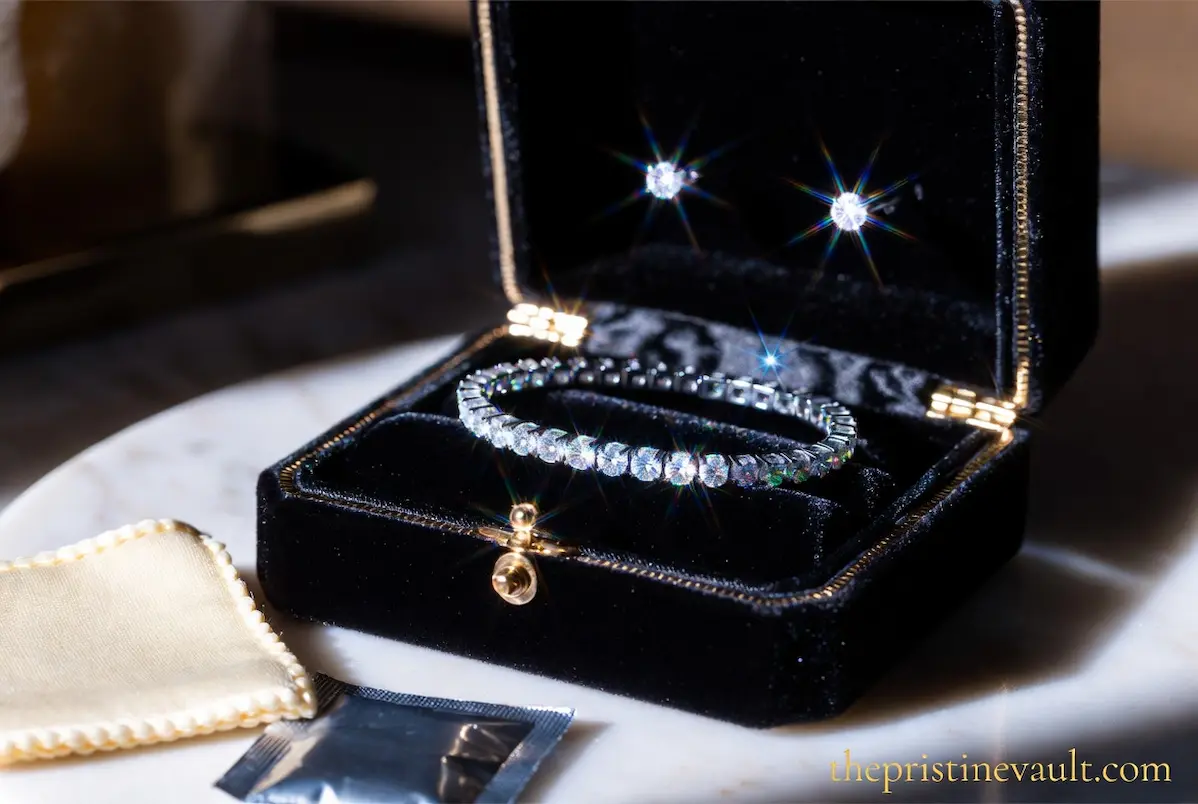
Storing diamond jewelry correctly is not about protecting the diamond -- it's about protecting everything around it. Diamonds rank 10 on the Mohs hardness scale. Every metal, every other gemstone, and every other piece of jewelry in your collection ranks lower.
A single diamond ring resting against a gold bracelet overnight will leave a permanent scratch on the bracelet. The diamond will be completely fine.
Most people understand that diamonds are hard. Fewer understand what that hardness means for storage. This guide covers the 8 rules that prevent damage, a piece-by-piece storage breakdown for rings, earrings, necklaces, bracelets, and combination pieces, the 7 most common storage mistakes, and a section on how proper storage affects appraisal and insurance value.
Table of Contents
- The 8 Rules for Storing Diamond Jewelry Safely
- Rule 1: One Piece Per Compartment -- No Exceptions
- Piece-by-Piece Diamond Jewelry Storage Guide
- 7 Storage Mistakes That Damage Diamond Jewelry
- Environment Guide: The Best and Worst Places to Store Diamond Jewelry
- Storage Documentation: Why Appraisals and Photos Matter
- Frequently Asked Questions
- Can I store all my jewelry together in one box?
Why Diamond Jewelry Damages Everything Else: The Mohs Scale Explained
Before choosing a storage method, understand exactly what you are dealing with. The Mohs scale measures how resistant a mineral is to being scratched. A material with a higher number will scratch anything with a lower number -- always, without exception, on contact.
Material | Mohs Hardness | Diamond Scratches It? | Storage Implication |
Diamond | 10 | N/A | Store separately from everything -- it scratches all other materials |
Sapphire / Ruby | 9 | Yes | Store in individual compartments -- diamonds will scratch even hard gemstones |
Topaz / Emerald | 7.5 - 8 | Yes | Emeralds are also brittle -- especially vulnerable to impact damage from loose diamonds |
Quartz / Amethyst | 7 | Yes | Any contact with a diamond piece causes scratching |
Platinum | 4 - 4.5 | Yes | The setting on your own diamond piece can be scratched by another diamond |
Gold (18k) | 2.5 - 3 | Yes | Gold scratches from a single contact event with a diamond. Damage is cumulative. |
Silver | 2.5 - 3 | Yes | Sterling silver scratches extremely easily from diamond contact |
Pearl | 2.5 - 4.5 | Yes | Pearls are organic and among the most vulnerable -- even soft contact causes permanent surface damage |
Opal | 5.5 - 6.5 | Yes | Opals are also brittle and dehydrate easily -- require completely separate storage |
The practical consequence: Every piece of diamond jewelry you own is capable of permanently scratching every other piece of jewelry you own. This is not a risk that depends on how carefully you store things -- it depends on whether the pieces touch. If they touch, the softer material is scratched.
Storage that prevents contact between pieces is the only solution.
ℹ️ Can diamonds scratch other diamonds? Yes. Two diamonds in contact will scratch each other at the girdle edge -- the thin band around the widest part of the stone. This is why loose diamonds are stored in individual folded paper parcels (called diamond papers) by professionals, never in the same container. Even two mounted diamond rings sharing a compartment can cause girdle chipping on contact. |
The 8 Rules for Storing Diamond Jewelry Safely
Rule 1: One Piece Per Compartment -- No Exceptions
This is the foundational rule. Every diamond piece must have its own individual compartment with soft lining -- velvet, microfiber, or suede. No other piece can share that compartment. Not temporarily.
Not just for the night. Any contact between a diamond piece and another piece causes scratching.
The lining material matters. Velvet and microfiber are gentle on metal surfaces and do not generate static that attracts dust. Avoid boxes with hard unlined wood or plastic interiors -- these scratch polished metal surfaces over time even without other jewelry present.
Rule 2: Use the Right Storage for Each Piece Type
Different jewelry types have different vulnerabilities. The storage solution that works for a ring is wrong for a necklace. See the piece-by-piece guide in the next section -- but at minimum:
Rings: Padded ring slots or original jeweler box. Never dropped loosely into a bowl or dish.
Necklaces: Hung individually on hooks inside a closed cabinet, or laid flat in long padded compartment. Never coiled.
Earrings: Earring book or padded holder with backs attached. Pairs kept together.
Bracelets: Flat in padded compartment. Tennis bracelets especially -- never coiled or stacked.
Storage Method | Scratch Risk | Best For | Humidity Control | Verdict |
Velvet-lined jewelry box (individual compartments) | Very low | Full collections | Add silica gel packet | ★★★★★ Gold standard |
Individual soft pouches (velvet or microfiber) | Very low | Single pieces, travel | Breathable -- no moisture trap | ★★★★★ Best per-piece protection |
Original jeweler box | None -- custom fit | Individual pieces | Good -- designed for the piece | ★★★★★ Best if available |
Ring holder tray (padded slots) | Very low | Ring collections | Add silica gel nearby | ★★★★☆ Excellent for rings |
Hanging necklace hooks (inside cabinet) | Low -- if isolated | Necklaces and bracelets | Keep cabinet dry | ★★★★☆ Best for chains |
Shared compartment (multiple pieces) | High -- contact inevitable | Never for diamond pieces | Irrelevant -- already wrong | ❌ Never use |
Open dish or tray on dressing table | Very high | Temporary only (< 1 hour) | None -- exposed to air | ❌ Avoid for storage |
Plastic zip-lock bag | Low if individual bags | Emergency travel only | Poor -- traps moisture long-term | ⚠️ Short-term only |
Rule 3: Control Humidity -- Add Silica Gel to Your Jewelry Box
High humidity tarnishes metal. Gold alloys -- particularly 10k and 14k, which contain more base metals -- develop a dull film in moist environments. Sterling silver tarnishes rapidly. Rhodium plating on white gold degrades faster. In tropical and coastal climates, these effects happen within weeks, not years.
Target humidity: 40-50% relative humidity in your storage area.
Silica gel packets: Place one or two inside or alongside your jewelry box. Replace every 2-3 months -- saturated silica gel provides no protection.
Digital hygrometer: A $10-20 device placed in your wardrobe tells you actual humidity levels. This is the difference between guessing and knowing.
Rule 4: Keep Diamond Jewelry Away from the Bathroom
The bathroom is the worst possible storage location for diamond jewelry. It combines the three conditions that damage settings fastest: sustained humidity, heat fluctuations as the room cycles between hot showers and cooled air, and airborne chemical exposure from perfume, hairspray, cleaning products, and soap residue.
That small dish next to the sink where rings sit while washing hands is causing damage every day -- not visibly at first, but cumulatively. Store all diamond jewelry in a bedroom closet, a dresser drawer, or a dedicated jewelry cabinet in a cool dry area.
Rule 5: Clean Before Storing -- Especially Before Long-Term Storage
Body oils, lotion, sunscreen, and perfume residue left on diamond jewelry during storage cause discoloration and dullness over time. On lower-karat gold, residue accelerates tarnishing at alloy points. The cleaning protocol before storage does not need to be elaborate:
Wipe each piece with a clean dry white microfiber cloth to remove surface oils and dust.
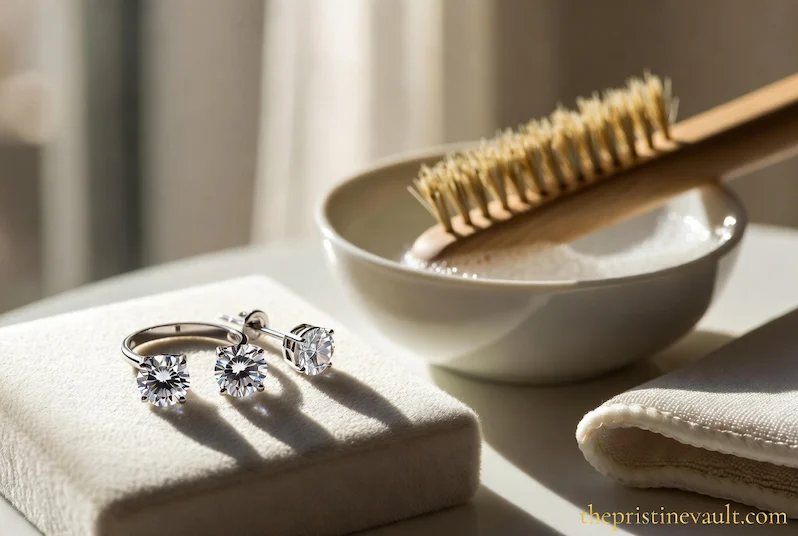
For a deeper clean before seasonal storage: soak in warm water with a drop of mild dish soap for 5-10 minutes. Gently scrub with a soft baby toothbrush, rinse thoroughly with warm water, and dry completely with a microfiber cloth before storing.
Never store wet or damp jewelry. Moisture trapped between a piece and its pouch or lining is an accelerated environment for tarnish and, in high humidity climates, mold on organic materials like pearls.
⚠️ Pro Tip: Clean your diamond jewelry immediately before storing, not immediately before wearing. Oils from handling the piece while putting it away re-contaminate the surface. The sequence is: clean, store. When retrieving for wear, the piece comes out clean. |
Rule 6: Check Prongs Before Every Long-Term Storage
A loose prong is how diamonds fall out of settings. And a diamond lost inside a jewelry box, a dresser drawer, or a storage pouch is sometimes never found. Prong checking takes less than a minute:
Hold the piece under good light and look at each prong. A prong that is bent, missing its tip, or clearly thinner than the others needs attention.
Gently press each prong with a fingernail. A prong in good condition will not move. Any prong that flexes or feels soft needs professional inspection before the piece goes into storage or is worn again.
Take any concern to a jeweler before storing. A prong re-tipping costs $20-60. A lost diamond from a loose prong costs multiples of that -- plus the emotional loss of the stone itself.
Rule 7: Store Away from Direct Sunlight and Heat Sources
A diamond itself will not be damaged by sunlight. But certain gemstones that often accompany diamonds -- particularly opals, amethyst, and some colored sapphires -- can fade with prolonged UV exposure.
Metal settings near windows experience repeated expansion and contraction from heat cycling that loosens prong settings over time.
Keep diamond jewelry away from windows, on top of dressers in sunlit rooms, and away from radiators or heating vents. An interior shelf in a closed wardrobe or a drawer in a bedroom dresser away from exterior walls is ideal.
Rule 8: Travel with a Dedicated Case -- Never in Checked Luggage
Checked luggage is subjected to compression, impact, and temperature extremes. It is also the most common context in which jewelry is lost through theft or mishandling. Diamond jewelry travels with you in carry-on or personal bag, always.
Dedicated travel jewelry case: Individual padded compartments, secure zipper or snap closure, soft interior lining. Compact enough for a carry-on.
Soft travel roll: A leather or fabric roll with individual pouches works well for lighter collections and packs flat.
Emergency backup: Individual zip-lock bags, one piece per bag, wrapped in a soft cloth. Prevents pieces from touching each other and provides basic protection when a proper case is unavailable.
Piece-by-Piece Diamond Jewelry Storage Guide
Each type of diamond jewelry has specific vulnerabilities that a generic storage approach does not address. Use this table to match the storage method to the specific piece:
Jewelry Type | Key Vulnerability | Storage Method | Critical Rule |
Diamond engagement ring | Prong snagging, stone protrusion hitting other pieces | Dedicated ring slot (padded, upright) or original jeweler box | Never drop loosely into a bowl or drawer -- one fall bends prongs |
Diamond stud earrings | Rolling, backs separating, loss | Earring book, padded earring holder, or small individual compartment with backs attached | Store with earring backs on -- loose backs are the #1 cause of earring loss |
Diamond necklace / pendant | Chain tangling, clasp stress, pendant swinging against other pieces | Hang on individual hook inside closed cabinet, or lay flat in long padded compartment, clasp closed | Never coil into a pile -- knots put permanent stress on chain links |
Diamond tennis bracelet | Flexible links bending permanently, clasp weakness | Flat in padded compartment -- never coiled or hung | Store flat always -- coiling a tennis bracelet bends the link connections over time |
Diamond drop / dangle earrings | Tangling with other pieces, hook bending | Individual padded slots or earring book with separate slots per pair | Keep pairs together -- loose dangle earrings are among the most commonly lost jewelry items |
Diamond + pearl combination pieces | Pearl surface damage from diamond contact, pearl dehydration | Separate from pure diamond pieces in a soft cloth pouch -- never in same compartment | Pearls rank 2.5-4.5 on Mohs -- a single contact with a diamond setting scratches them permanently |
Loose diamonds (unmounted) | Diamond scratching other diamonds at girdle edges, loss | Individual folded paper parcels (diamond papers) or individual foam-lined containers | Never store loose diamonds together -- they scratch each other at the girdle edge |
7 Storage Mistakes That Damage Diamond Jewelry
Mistake | What Happens to Your Jewelry | The Fix |
Storing multiple pieces in a shared compartment | Diamond scratches gold, platinum, silver, and softer gemstones on first contact. Damage is cumulative -- a thin scratch today becomes a visible groove within months. | One piece per compartment. No exceptions for diamond jewelry. |
Storing in the bathroom | Combines humidity (accelerates tarnish on gold alloys and silver), heat fluctuations (expands and contracts metal settings, loosening prongs), and airborne chemicals from perfume and cleaning products. | Bedroom closet, dresser drawer, or dedicated jewelry cabinet only. Cool, dry, away from chemical exposure. |
Dropping rings into a bowl or dish | The stone protrudes on most ring settings. One drop onto a hard surface can bend a prong. A bent prong is how diamonds fall out of settings -- and a lost diamond is not always recoverable. | Dedicated padded ring slot or original jeweler box every time. Never temporary dishes, even for a few minutes. |
Coiling necklaces into a pile for storage | Knots form under coiling that put stress on delicate chain links. Fine chains can be nearly impossible to unknot without tools, and attempting to unknot them stresses the links further. | Hang on individual hooks inside a closed cabinet, or lay flat in a long padded compartment with clasp closed. |
Leaving body oils and lotions on jewelry before storage | Skin oils, lotion, sunscreen, and perfume residue left on metal and settings during storage cause gradual discoloration and dullness over time. On lower-karat gold (10k, 14k), this accelerates tarnishing at alloy points. | Wipe each piece with a clean dry microfiber cloth before storing. Clean properly before any long-term storage. |
Storing in humid environments without silica gel | High humidity tarnishes gold alloys and silver. In tropical climates, settings can corrode from the inside over years, weakening prong structures invisibly until a stone becomes loose. | Add silica gel packets to the jewelry box. Replace every 2-3 months. Use a digital hygrometer in the storage area if you live in a high-humidity climate. |
Never checking prong condition before long-term storage | A prong that is already slightly bent or worn when you put the jewelry away for the season will worsen during storage from any movement. By the time you retrieve the piece, the stone may be loose -- or missing. | Check every prong by pressing gently with a fingernail before storing. Any prong that moves goes to a jeweler before it goes into storage. |
Environment Guide: The Best and Worst Places to Store Diamond Jewelry
Where you store diamond jewelry matters almost as much as how you store it. Environmental conditions affect the metal, the setting, and any accompanying gemstones continuously -- even when the piece is not being worn.
Best Storage Locations
Interior bedroom closet: Stable temperature and humidity, away from direct sun, no chemical exposure. Ideal.
Bedroom dresser drawer: Slightly more temperature-variable than a closet but still far better than a bathroom or kitchen. Add silica gel packets.
Dedicated jewelry cabinet: The best option for larger collections. Look for cabinets with soft interior lining, individual compartments, and a lock for security.
Home safe or safety deposit box: For high-value pieces worn infrequently. A fireproof safe with silica gel inside provides maximum protection. Wrap each piece individually in a soft pouch before placing inside.
Worst Storage Locations
Bathroom: Humidity, heat cycles, chemical exposure. Avoid entirely.
Kitchen: Heat and cooking vapors accelerate tarnishing. Food residue and grease in the air settle onto surfaces.
Windowsill or sunny dresser top: UV exposure and heat cycling damage settings and companion gemstones.
Car glove compartment: Temperature extremes in a parked car reach levels that expand metal settings, loosen adhesive in certain treatments, and dehydrate organic materials like pearls.
Attic or basement: Extreme temperature and humidity fluctuations. Both accelerate every form of jewelry damage.
Storage Documentation: Why Appraisals and Photos Matter
Proper storage protects your jewelry physically. Proper documentation protects its value financially. These two things work together -- and most jewelry owners only think about documentation after a loss has occurred.
What to Document and Where to Keep It
Photographs: Photograph each significant piece from multiple angles in good natural light. Include close-ups of any unique characteristics, markings, or damage for reference. Store photos in cloud backup.
Appraisals: A certified appraisal from a GIA-trained gemologist establishes the replacement value of each piece. For insurance purposes, appraisals should be updated every 2-3 years as diamond values fluctuate. Keep physical copies in a fireproof safe and digital copies in cloud storage.
GIA certificates: If your diamond came with a GIA grading report, keep this documentation permanently. It establishes the specific characteristics of the stone and is required for insurance and resale.
Purchase receipts: For new pieces, retain the original receipt. For estate or pre-owned pieces, retain any provenance documentation available.
Insurance Coverage for Diamond Jewelry
Standard homeowner's and renter's insurance policies typically cover jewelry up to a sublimit of $1,000-2,500 total for all jewelry combined -- far below the replacement value of most diamond collections.
A jewelry floater or scheduled personal property rider covers specific pieces at their appraised value, with significantly broader coverage including mysterious disappearance and accidental loss.
Real scenario: A diamond engagement ring valued at $8,500 stored in a shared compartment with a gold bracelet. After 18 months, the ring's prongs have minor wear from contact, the bracelet has two visible scratches across the surface, and the ring setting has light surface abrasion.
Standard homeowner's insurance covers none of this -- it is considered wear from storage, not a covered loss event. A jewelry floater with an updated appraisal would have covered accidental damage from the outset.
Frequently Asked Questions
Can I store all my jewelry together in one box?
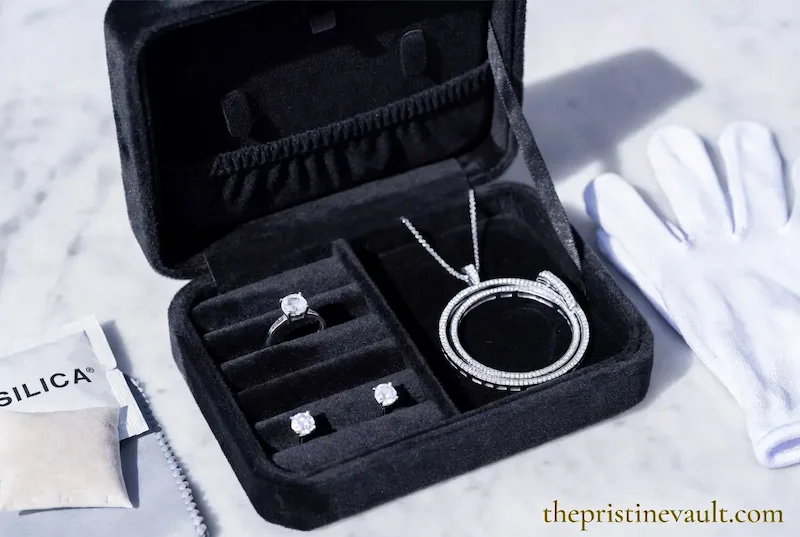
Yes -- if and only if every piece has its own individual compartment with soft lining, and no piece can touch another. The goal is preventing all contact between pieces. A jewelry box with separate velvet-lined compartments works well for this. A shared space where pieces can move and contact each other does not, regardless of how nice the box looks.
Do diamonds scratch other diamonds in storage?
Yes. Two diamonds can scratch each other at the girdle edge -- the thin band around the widest part of the stone -- on direct contact. This is why professional jewelers store loose diamonds in individual folded paper parcels, never together.
For mounted diamond jewelry, keep each piece in its own compartment to prevent stone-on-stone contact.
Should I store diamond jewelry in a safe?
For high-value or rarely-worn pieces, a fireproof home safe is a sensible addition to your storage setup. Keep these points in mind: line the safe with silica gel packets to control humidity inside the sealed environment, wrap each piece individually in a soft pouch before placing inside, and update your insurance appraisals to reflect current values if the pieces are insured.
How often should I have diamond settings professionally inspected?
Once a year by a jeweler, and any time you notice a prong that moves or a stone that feels loose. A jeweler can spot worn prongs, microscopic setting damage, and early signs of metal fatigue that are not visible to the naked eye.
Professional inspection costs nothing at most jewelers where you purchased the piece, and catches problems before they become lost stones.
Pearl jewelry requires an entirely different care approach than pure diamond pieces. Before storing any combination pieces, our step-by-step guide on how to clean pearl jewelry at home walks through the exact technique that keeps pearl surfaces intact without damaging the drill holes or silk thread.
Is it okay to store diamond jewelry in plastic zip-lock bags?
For short-term travel -- a few days -- individual zip-lock bags with one piece per bag are acceptable as an emergency solution. For long-term storage, avoid plastic: it traps moisture as the jewelry and air inside the bag exchange humidity, and creates condensation that accelerates tarnishing. Fabric pouches or lined boxes are always better for anything beyond a few days.
How do I prevent diamond necklaces from tangling?
Hang each necklace on its own hook inside a closed jewelry cabinet with the clasp closed. This is the most reliable method. If hanging is not practical, lay each necklace flat in its own long padded compartment with the clasp closed.
Clasping the chain before storage reduces internal movement that causes tangling. Never coil a necklace into a pile -- the knots that form under coiling can be nearly impossible to remove without stressing the chain links.
Can humidity really damage diamonds?
Humidity does not damage the diamond itself -- but it absolutely damages the metal setting holding the diamond. Gold alloys tarnish, silver tarnishes rapidly, and prong settings corrode from the inside in sustained high-humidity environments. Over years, this weakens the setting's grip on the stone.
The diamond survives; the setting that holds it may not.
Final Thoughts
Eight rules protect your entire diamond jewelry collection: one piece per compartment, the right storage type for each piece, silica gel for humidity, no bathroom storage, clean before storing, check prongs before long-term storage, away from sunlight and heat, and a dedicated case for travel.
Add documentation and insurance coverage and the physical protection you've built translates into financial protection as well.
None of this requires expensive equipment. A velvet-lined jewelry box with individual compartments, a pack of silica gel, a microfiber cloth, and the habit of checking prongs before storing covers almost everything.
The investment is minimal. The protection is substantial.
Now it's your turn -- open your current jewelry storage today, separate any pieces that are sharing compartments, add silica gel if you don't have any, and check the prongs on any piece that's been sitting unworn for more than a month.
Your diamonds will thank you for it.
Editorial Notice: This article is for informational purposes only. Jewelry care recommendations may vary by specific piece, setting type, and metal composition. For high-value or vintage pieces, professional jeweler consultation is always recommended. This article may contain affiliate links -- we earn a small commission at no extra cost to you.