Watch Winder Settings for Rolex: 5 Proven Steps to Get It Right

Getting your watch winder settings for Rolex wrong doesn't just stop the watch — it can stress the movement and lead to premature service costs running into thousands.
Your $9,000 Rolex Submariner sits in a watch winder running at 1,800 turns per day. You thought more turns meant better winding. You were wrong.
Excessive TPD (turns per day) keeps the mainspring under constant maximum tension. Over months and years, this accelerates wear on the automatic winding mechanism — the reverser wheels, the rotor bearings, the click spring. Components designed to last a decade start failing in five years.
A collector brought me his Rolex GMT-Master II with a grinding sensation during hand-winding. His watchmaker diagnosed worn reverser wheels. The cause? Three years in a winder set to 1,500 TPD bidirectional — roughly double what the movement actually needed. Service cost: $1,400.
The frustrating part? Correct settings would have prevented the entire problem.
This guide covers the exact watch winder settings for every modern Rolex caliber. You'll learn the right TPD range, correct rotation direction, and the common mistakes that silently damage Rolex movements in winders worldwide.
Here's everything you need to know.
Table of Contents
- Editor's Picks: Best Watch Winders for Rolex
- Understanding TPD: What Your Rolex Actually Needs
- Rotation Direction: Why Clockwise Matters for Rolex
- Rest Periods: The Setting Most Owners Ignore
- Complete Rolex Winder Settings by Model
- Choosing the Right Winder for Rolex
- 6 Quick Tips for Rolex Winder Settings (Most Owners Skip These)
- Mistakes That Damage Rolex Movements in Winders
- Frequently Asked Questions
- Conclusion
This post contains affiliate links. We may earn a small commission at no extra cost to you.
Editor's Picks: Best Watch Winders for Rolex
Before we dive in, here are the top-rated watch winders most Rolex collectors trust:
- Wolf 1834 Single Winder — Precision TPD control, whisper-quiet motor, proven Rolex compatibility
- JQUEEN Double Watch Winder — Budget-friendly, adjustable TPD and direction
(More recommendations throughout the article)
Understanding TPD: What Your Rolex Actually Needs
TPD — turns per day — is the total number of rotations your winder makes in 24 hours. Getting this number right is the foundation of proper winder settings.
How Rolex Automatic Movements Wind
Every Rolex automatic movement uses a perpetual rotor — a weighted half-disc that spins freely as the watch moves. This rotor winds the mainspring through a series of reverser wheels and gears.
The movement doesn't need constant winding. It needs enough turns to maintain full power reserve. Once the mainspring reaches maximum tension, additional winding is unnecessary and creates passive stress on winding components.
The Magic Number: 650-800 TPD
All modern Rolex calibers (3135, 3235, 3285, 4130, 4131) operate optimally at 650-800 TPD.
That's significantly less than most winder default settings. Many winders ship preset at 1,200-1,800 TPD — far too aggressive for Rolex movements.
Here's the breakdown:
| Rolex Caliber | Used In | Recommended TPD | Direction |
|---|---|---|---|
| 3235 | Submariner, Datejust 41, Explorer | 650-800 | Clockwise |
| 3285 | GMT-Master II, Batgirl | 650-800 | Clockwise |
| 3230 | Explorer, OP 36mm | 650-800 | Clockwise |
| 4130 | Daytona | 650-800 | Clockwise |
| 4131 | New Daytona 2023+ | 650-800 | Clockwise |
| 3135 | Older Submariner, Datejust | 650-800 | Clockwise |
| 3186 | Older GMT-Master II | 650-800 | Clockwise |
Notice the pattern? All modern Rolex calibers use the same TPD range and the same direction. This makes setting your winder straightforward once you understand the basics.
For detailed winder recommendations specific to Rolex Datejust models, our guide on best watch winders for Rolex Datejust covers compatible options with preset Rolex settings.
The next section covers the mistake most people make at this stage.
Rotation Direction: Why Clockwise Matters for Rolex
Direction isn't arbitrary. It's engineered into each movement's winding mechanism.
How Direction Affects Winding Efficiency
Rolex perpetual movements wind in one direction only: clockwise (when viewed from the caseback).
When the rotor spins clockwise, the reverser wheels engage and transfer energy to the mainspring. When the rotor spins counterclockwise, the reverser wheels disengage — the rotor spins freely without winding.
What Happens with Wrong Direction Settings
Counterclockwise only: Your winder runs all day but never actually winds the watch. The rotor spins freely each rotation without engaging the winding mechanism. Your Rolex will lose power reserve and eventually stop — defeating the entire purpose.
Bidirectional: The winder alternates between clockwise and counterclockwise rotations. Only half the turns actually wind the watch. You need to double your TPD setting to achieve effective winding — which means more total rotation and unnecessary wear on the rotor bearings.
The Correct Setting
Set your winder to: Clockwise only
This ensures every single turn contributes to winding. Your 650-800 TPD setting delivers 650-800 effective winding turns. Clean, efficient, minimal stress.
A collector ran his Submariner in a bidirectional winder at 800 TPD for two years. Effectively, only 400 turns per day were actually winding the watch. The Rolex would intermittently stop — fully wound one week, dead the next. Switching to clockwise-only at 750 TPD eliminated the problem completely.
But setting direction correctly is only half the battle — here's what rest periods do for your movement.
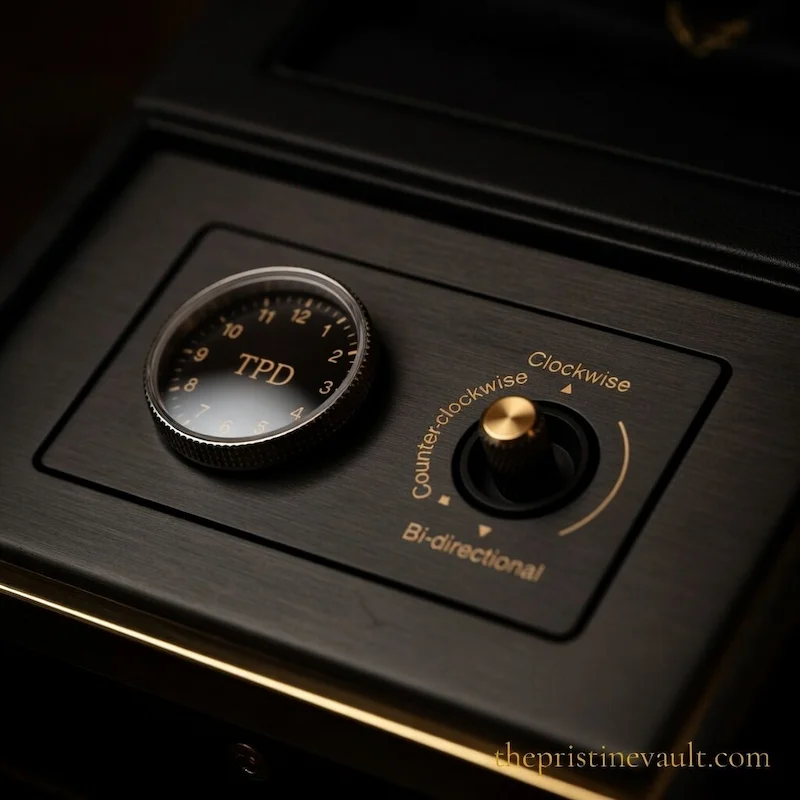
Rest Periods: The Setting Most Owners Ignore
Continuous rotation is unnecessary and potentially harmful. Proper winders incorporate rest periods between rotation cycles.
Why Rest Matters
When you wear a Rolex on your wrist, it doesn't experience constant rotation. You move, you stop, you sit at a desk, you sleep. The watch experiences intermittent winding throughout the day.
Continuous rotation in a winder doesn't mimic real wear patterns. It keeps the rotor in near-constant motion, wearing bearings faster than natural use would.
Ideal Rest Cycle Programming
Recommended pattern:
Rotate: 30-60 seconds
Rest: 3-5 minutes
Repeat throughout 24 hours
Total effective rotations: 650-800 TPD
Most quality winders handle this automatically. Cheap winders often rotate continuously for hours, then stop for hours — creating uneven winding patterns.
How to Check Your Winder's Cycle
Listen to your winder over a 30-minute period. You should hear:
- Brief motor rotation (30-60 seconds)
- Silence (several minutes)
- Brief motor rotation again
- Silence again
If your winder runs continuously for 10+ minutes without stopping, it lacks proper rest cycle programming. Consider upgrading.
👉 Check Watch Winders with Programmable Rest Cycles on Amazon
For collectors who prefer not using winders at all, our guide on how to store watches without a watch box covers safe alternative storage methods.
Up next: the exact setup process for your winder.
Complete Rolex Winder Settings by Model
Let me break down specific settings for the most popular Rolex models.
Sport Models (Submariner, GMT-Master II, Explorer)
TPD: 650-800
Direction: Clockwise
Rest cycles: Yes (intermittent)
Power reserve when removed: ~70 hours (caliber 3235/3285)
Worth noting: the Explorer I (124270) and new Explorer II use caliber 3230 — same settings apply.
Dress Models (Datejust, Day-Date)
TPD: 650-800
Direction: Clockwise
Rest cycles: Yes
Power reserve: ~70 hours (caliber 3235)
Identical settings to sport models. The caliber 3235 is used across both categories.
Older Datejust models (pre-2020) use caliber 3135 with approximately 48-hour power reserve. Same TPD and direction settings apply, but the watch stops sooner after winder removal.
Chronograph (Daytona)
TPD: 650-800 Direction: Clockwise Rest cycles: Yes (gentler cycling preferred) Power reserve: ~42-48 hours (varies by caliber)
The Daytona's chronograph complication doesn't change winder requirements. The winding mechanism operates independently from the chronograph functions.
However, avoid running the chronograph while the watch is in the winder. The chronograph seconds hand vibration combined with winder rotation creates unnecessary stress.
Vintage Rolex Models (Pre-2000)
TPD: 650-800 Direction: Clockwise Rest cycles: Yes (gentler cycling preferred) Power reserve: ~42-48 hours (varies by caliber)
Vintage calibers (1570, 3035, 3135 early versions) use the same directional winding but with shorter power reserves. The lower power reserve means the watch stops sooner when removed, but winder settings remain identical.
For valuable vintage pieces, consider whether a winder is appropriate at all. Some watchmakers recommend against winding vintage movements continuously due to aged lubricants and potentially worn components.
For comprehensive storage options beyond winders, our luxury watch storage box review covers protection solutions for both active and stored timepieces.
The next section covers the mistake most people make at this stage.
Choosing the Right Winder for Rolex
Not all winders handle Rolex settings correctly. Here's what to look for.
Essential Winder Features
Adjustable TPD: Must allow setting between 650-800. Winders with only preset options (Low/Medium/High) often don't hit this range accurately.
Directional control: Must offer clockwise-only setting. Winders with only bidirectional rotation waste half their turns on Rolex movements.
Quiet motor: Winders sit on nightstands and in closets. Noisy motors become intolerable within days.
Cushion sizing: Must accommodate Rolex's case size and bracelet width. Some winder cushions are too small for Submariner or GMT-Master II on bracelet.
Motor Quality Matters
Cheap winder motors generate magnetic fields that can magnetize watch movements. Magnetized movements run fast — sometimes gaining 30-60 seconds per day.
Quality winders use shielded motors specifically designed to prevent magnetization. This detail alone justifies spending $80-150 versus $30-50.
👉 Check Magnetically Shielded Watch Winders on Amazon
For Omega collectors comparing winder requirements, our Omega Speedmaster winder guide highlights how settings differ between brands.
6 Quick Tips for Rolex Winder Settings (Most Owners Skip These)
Start at 650 TPD and increase only if the watch consistently stops. Lower TPD means less wear on winding components. Only increase if needed.
Remove your Rolex from the winder at least once monthly. Wind it manually 20-30 turns and wear it for a day. This distributes lubricants differently than winder rotation alone.
Position the winder away from speakers and electronics. Magnetic fields from nearby devices can magnetize your movement even with shielded winder motors.
Check power reserve after 48 hours off the winder. If your Rolex stops within 48 hours of removal (modern caliber), your TPD setting may be too low.
Clean winder cushions monthly. Dust and debris on cushions transfer to bracelets and casebacks, causing micro-scratches over time.
Replace winder motors every 5-7 years. Aging motors develop stronger magnetic fields and less consistent rotation patterns. Budget for replacement before failure damages your watch.
⚠️ Pro Tip: If you own multiple Rolex watches, you don't need a winder for each one. Rotate which watches sit in winders based on wearing schedule. Watches you'll wear within 2-3 days don't need winding — the 70-hour power reserve of modern calibers covers that gap.
👉 Get Multi-Watch Winder for Rolex Collection on Amazon
Mistakes That Damage Rolex Movements in Winders
These common errors cause preventable wear and expensive service:
Setting TPD above 1,000. Excessive turns per day keep the mainspring at maximum tension continuously. This stresses the click spring and reverser wheels beyond design parameters. Stick to 650-800 TPD maximum.
Using bidirectional rotation. Rolex movements only wind clockwise. Bidirectional settings waste half the rotation on non-winding counterclockwise turns. This doubles rotor bearing wear for no winding benefit.
Running the chronograph in the winder. Leaving a Daytona's chronograph running while in a winder creates vibration that compounds with rotation. Over months, this can affect chronograph accuracy.
Placing winders near strong magnets. Speakers, laptop chargers, magnetic phone mounts, and even refrigerators generate magnetic fields. Magnetized movements run fast and require professional demagnetization ($50-100 per visit).
Never servicing the winder itself. Winder motors degrade over time. Worn motors develop inconsistent rotation speeds and stronger magnetic fields. Service or replace winder motors every 5-7 years.

Frequently Asked Questions
What TPD should I set for a Rolex Submariner?
Set 650-800 TPD, clockwise direction. The Submariner uses caliber 3235 (current generation) or 3135 (previous generation). Both calibers use the same winder settings. Start at 650 TPD and increase only if the watch consistently stops.
Can a watch winder damage my Rolex?
Yes, if settings are wrong. Excessive TPD (above 1,000) accelerates wear on winding components. Wrong direction (counterclockwise) prevents winding entirely. Cheap unshielded motors can magnetize movements. Correct settings eliminate these risks.
Do all Rolex watches wind clockwise?
All modern Rolex automatic movements wind in the clockwise direction when viewed from the caseback. This has been consistent across Rolex calibers for decades. Always set your winder to clockwise-only for any Rolex automatic.
Is it bad to leave my Rolex in a winder permanently?
Not with correct settings. Continuous winding at appropriate TPD (650-800) with rest cycles doesn't damage modern Rolex movements. However, removing the watch monthly for manual winding and wearing distributes lubricants more completely than winder rotation alone.
What happens if I set TPD too low?
The watch will stop between winder cycles. This isn't damaging — starting and stopping doesn't harm automatic movements. Simply increase TPD by 50-100 until the watch maintains consistent timekeeping. For detailed storage alternatives, see our guide on how to store watches properly without a watch box.
Should I use a winder for my vintage Rolex?
Proceed cautiously. Vintage movements may have aged lubricants, worn components, or delicate parts that continuous winding stresses. If your vintage Rolex hasn't been serviced recently, manual winding when you want to wear it is safer than continuous winder use.
How do I know if my winder magnetized my Rolex?
Your Rolex will consistently run fast — gaining 30-60+ seconds per day. Place a compass near the watch. If the compass needle deflects, your watch is magnetized. Professional demagnetization costs $50-100 and takes minutes.
Conclusion
Correct watch winder settings for Rolex come down to three numbers: 650-800 TPD, clockwise direction, and intermittent rest cycles throughout each 24-hour period.
These settings apply across virtually every modern Rolex caliber — from Submariner to Daytona, Datejust to Day-Date. The consistency makes setup straightforward once you understand the fundamentals.
Wrong settings cause real damage. Excessive TPD wears winding components prematurely. Wrong direction prevents winding entirely. Unshielded motors magnetize movements. Each mistake costs hundreds or thousands in preventable service.
Invest in a quality winder with precise TPD control and clockwise-only capability. The $100-200 difference between a proper winder and a cheap alternative protects a watch worth thousands.
Now it's your turn — check your current winder settings against the specifications above and adjust today. Your Rolex will thank you for it.