How to Remove Scratches from Watch Bezel: The Complete Guide
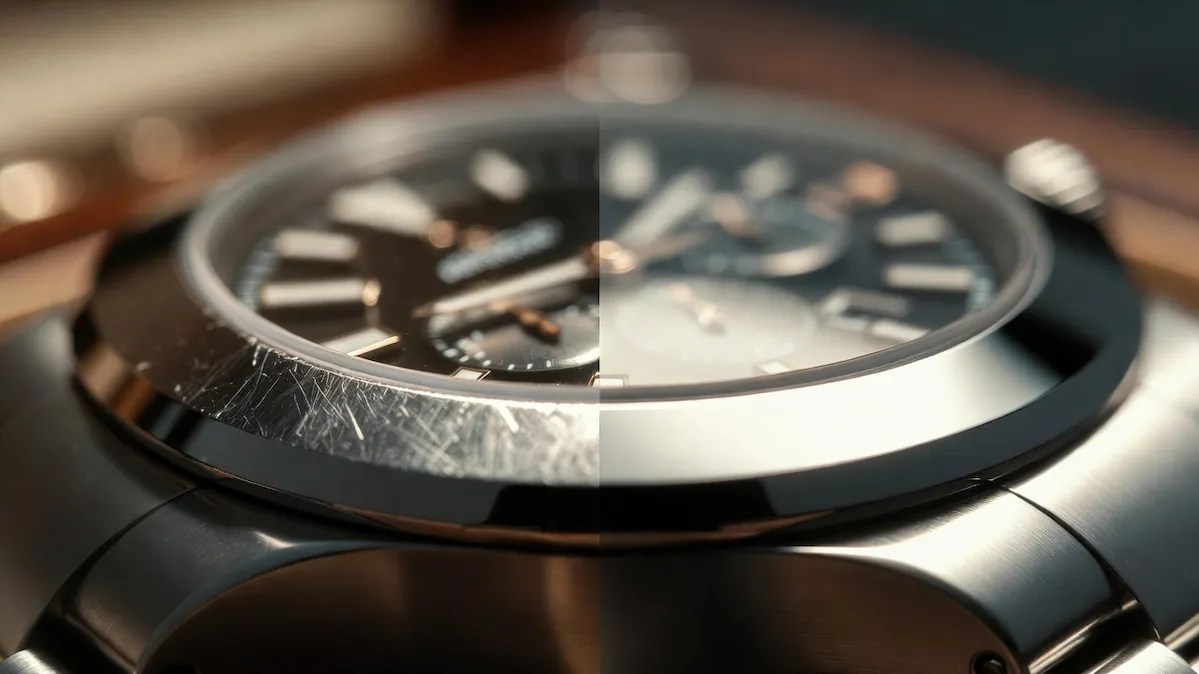
Knowing how to remove scratches from a watch bezel is one of the most valuable skills a luxury watch owner can develop. A single careless brush against a countertop can turn a flawless bezel into an eyesore. The good news is that most scratches are far more manageable than they appear. Whether you are dealing with a hairline mark on your Rolex Submariner or a deeper gouge on your Omega Seamaster, the right approach makes all the difference.
Your watch is more than a timekeeping device. For most owners of quality timepieces, it represents a financial investment and a personal statement. Even the smallest scratch on a perfectly brushed or polished bezel can feel like a serious blow.
The reality is that surface scratches are almost always fixable. You do not always need to ship your watch off to a service center for weeks.
This guide covers safe and proven methods for removing bezel scratches at home. You will also learn when to call a professional and how to protect your watch going forward.
Understanding Your Watch Bezel Material
Before reaching for a polishing cloth, you need to know what your bezel is made of. Using the wrong method on the wrong material causes more damage than the original scratch.
Table of Contents
- Understanding Your Watch Bezel Material
- Tools You Need Before Starting
- How to Remove Scratches from a Stainless Steel Bezel
- Polishing Gold and PVD-Coated Bezels
- When to See a Professional
- How to Prevent Future Scratches
- Frequently Asked Questions
- Can I use toothpaste to remove scratches from a watch bezel?
- How much does professional watch bezel polishing cost?
- Will polishing a watch bezel affect its value?
- How do I know if my bezel has a brushed or polished finish?
- Can scratches be removed from a Rolex bezel at home?
- Is it safe to use a Dremel or rotary tool on a watch bezel?
- How long does it take to polish a watch bezel at home?
- Final Thoughts
The Most Common Bezel Materials
Stainless steel is the most common and fortunately the most forgiving for DIY polishing. Most everyday luxury watches use this material.
Ceramic is extremely scratch-resistant but nearly impossible to repair at home once damaged. Scratches often require professional intervention or part replacement.
Gold requires very gentle handling. Solid gold is workable but plated gold can wear through with aggressive polishing.
PVD and DLC coatings are thin surface treatments. These can be polished off entirely if you are not careful. Treat them with extreme caution.
Titanium is lightweight, durable, and workable with the right compounds. However, it scratches more easily than steel.
Knowing your material determines what is possible. A scratched ceramic bezel may need replacement. A scratched stainless steel bezel is often a 30-minute fix at home.
Tools You Need Before Starting
Gather everything before you begin. Stopping midway to hunt for supplies leads to uneven results.
Your Basic Kit
Multiple microfiber cloths are essential. Never reuse a dirty one during polishing.
Watch-safe masking tape or painter's tape protects surrounding surfaces from accidental scratches.
Metal polish compound such as Polywatch or Flitz works well for most steel bezels.
A soft-bristled toothbrush helps apply compound evenly in hard-to-reach areas.
Rodico cleaning putty removes compound residue from crevices and tight spaces.
A loupe or magnifying glass helps assess scratch depth before and after polishing.
Cotton swabs allow precision work on small scratches.
Assess Scratch Depth First
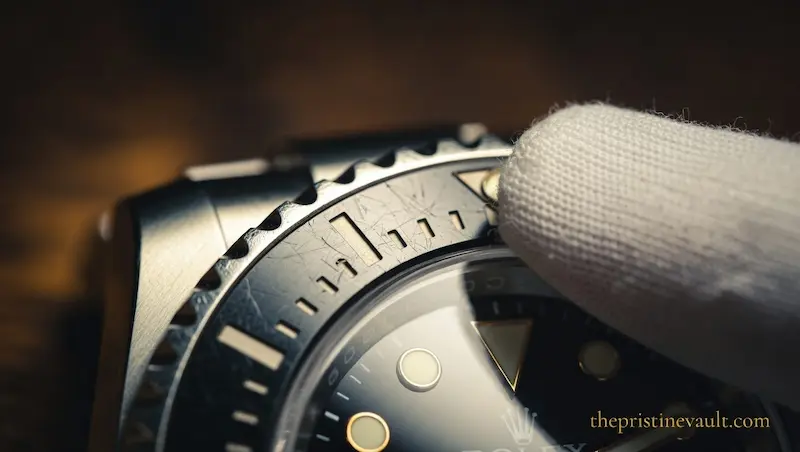
Run your fingernail across the scratch before starting any work. If your nail catches, the scratch is deeper than a surface scuff. Deep scratches may need professional attention rather than DIY polishing.
How to Remove Scratches from a Stainless Steel Bezel
Stainless steel is where most DIY success happens. The process differs depending on whether your bezel has a brushed or polished finish.
Polished Bezels
A polished finish means mirror-like shine. Restoring it requires careful technique.
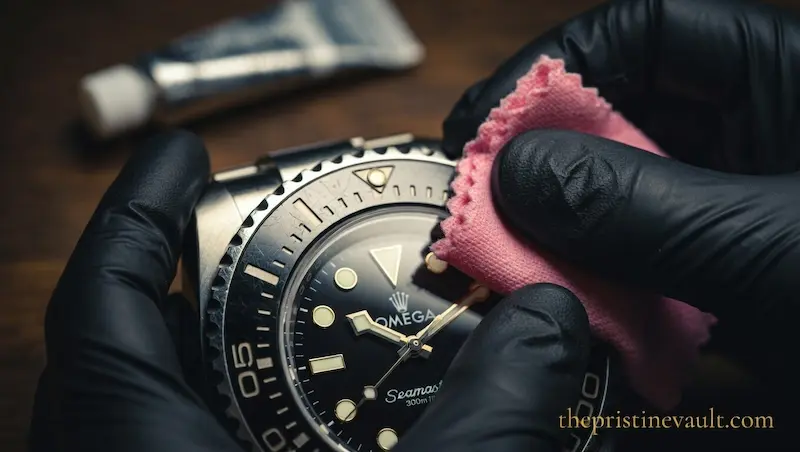
Clean the bezel thoroughly with a microfiber cloth to remove any grit. Small particles cause new scratches during polishing.
Apply a small amount of metal polish to a clean cloth. Less is better than more.
Work in small circular motions over the scratched area. The circular motion blends the scratch into surrounding polish uniformly.
Wipe away residue and assess under good lighting. Natural daylight works best.
Repeat as needed. Finish with a clean buffing cloth once satisfied.
Brushed Satin Bezels
Brushed finishes are directional. Circular polishing will ruin them. This requires a different approach.
Use a fine polishing stick or brass bristle brush designed for brushed finishes.
Work only in the direction of the existing grain lines. Never go against the grain.
Apply very light and even pressure throughout. Heavy pressure removes too much metal.
Alternate between polishing and assessing under light. Stop as soon as the scratch disappears.
This is genuinely one of the trickier DIY tasks. If you are not confident after a few passes, stop. Going too far removes metal and changes the finish permanently.
Polishing Gold and PVD-Coated Bezels
Gold and coated bezels demand a lighter touch. The risk here is not just cosmetic. You can thin the plating or remove the coating entirely.
Solid Gold Bezels
Use a gold-specific polishing cloth only. Avoid abrasive compounds entirely.
Light surface scratches on solid gold often buff out beautifully with a Sunshine Polishing Cloth and minimal pressure. Let the cloth do the work.
PVD and DLC Coatings
These are the most frustrating to deal with at home. PVD coatings are incredibly thin. Most polishing compounds cut right through them.
For minor surface marks, a clean microfiber cloth and a tiny amount of mild soap solution is your safest option. Do not use any abrasive compounds.
For anything deeper, professional re-coating is the only real solution. Accept this limitation before causing more damage.
Ceramic Bezels: What You Can and Cannot Do
Ceramic is prized for being highly scratch-resistant. This is great until it does get scratched. Because ceramic is so hard, conventional polishing compounds do not work.
What You Can Try
Polywatch polish is designed for acrylic crystals but sometimes works on light surface marks. Results vary depending on scratch depth.
A cerium oxide paste on a felt buffing wheel works for those comfortable with rotary tools. This requires experience and careful technique.
What You Should Skip
Metal polish compounds will not work on ceramic. They may leave residue that is difficult to remove.
Abrasive sandpaper causes far more damage than the original scratch. Never use it on ceramic.
Deep scratches on ceramic bezels typically require bezel replacement. Many manufacturers offer this service. Factor this into your ownership costs for ceramic-bezeled watches.
For more on protecting your watch investment, see our guide on luxury watches as inflation-proof portfolios.
When to See a Professional
There is no shame in calling a watchmaker. For certain situations, professional service is the only smart move.
Consider Professional Service When
The scratch is deep enough to catch your fingernail. Surface polishing will not fix it.
Your watch has a PVD, DLC, or ceramic bezel. These materials do not respond well to home methods.
The bezel has engravings or markings that could be damaged during polishing.
Your watch is a high-value collector piece where DIY risk simply is not worth it.
You have tried at-home methods and are not satisfied with the result.
A qualified watchmaker or brand service center can re-brush or re-polish bezels to factory specifications. This restores the original finish perfectly.
Cost varies depending on the brand and complexity. Budget anywhere from $50 to $300 or more.
How to Prevent Future Scratches
Once you have restored your bezel, keep it looking that way. Prevention costs nothing compared to repair.
Rotate Your Watches
Wearing the same piece every day accelerates wear on all surfaces. Rotation extends the pristine condition of each watch.
Use Proper Storage
A watch roll or cushioned case prevents metal-on-metal contact in storage. Never store watches loose in a drawer.
Remove Your Watch for Manual Work
Gardening, gym sessions, and home repairs are bezel killers. Take thirty seconds to remove your watch before physical activity.
Apply a Protective Coating
Products like Gyeon Watch Coat add a nano-ceramic protective layer. This provides an invisible barrier against minor scratches.
Clean Regularly
Dirt and grit are abrasive. A weekly wipe-down with a microfiber cloth prevents micro-scratching. This simple habit makes a significant difference over time.
Avoid Hard Surfaces
Never place your watch face-down on hard surfaces. This seems obvious but gets overlooked constantly.
Frequently Asked Questions
Can I use toothpaste to remove scratches from a watch bezel?
Toothpaste is mildly abrasive and works on some acrylic watch crystals. However, it is not recommended for metal bezels. Toothpaste leaves residue in crevices and provides inconsistent results. Use proper metal polish instead.
How much does professional watch bezel polishing cost?
Costs vary widely. An independent watchmaker might charge $50 to $100. Brand service centers typically bundle polishing with a full service, which can run $300 to $800 or more.
Will polishing a watch bezel affect its value?
For modern watches, light polishing usually has minimal impact on value. For vintage or collector watches, over-polishing can actually reduce value. Patina and original finish are part of the appeal for serious collectors. When in doubt, leave it alone.
How do I know if my bezel has a brushed or polished finish?
Look at the surface under natural light. A polished finish reflects like a mirror. A brushed finish shows fine parallel lines and has a softer matte sheen.
Can scratches be removed from a Rolex bezel at home?
Light surface scratches on stainless steel Rolex bezels can be addressed at home with care. However, Rolex uses specific finishing techniques including combinations of brushed and polished surfaces. Professional service often delivers the most authentic result.
Is it safe to use a Dremel or rotary tool on a watch bezel?
Only if you have significant experience. A rotary tool removes material quickly and can ruin a bezel in seconds. If you are not experienced with watchmaking tools, skip it entirely.
How long does it take to polish a watch bezel at home?
A light surface polish on a stainless steel bezel typically takes 20 to 45 minutes including preparation and cleanup. Deeper scratches requiring multiple passes may take longer.
Don't leave your hard-earned assets vulnerable to theft or unforeseen loss. Discover our comprehensive guide on luxury asset insurance and documentation to ensure your collection is fully protected by law and policy
Final Thoughts
Learning how to remove scratches from a watch bezel is a skill that pays off every time you look at your wrist. With the right tools, an understanding of your bezel material, and a patient approach, most surface scratches are entirely reversible at home.
The key is matching your method to the finish. Brushed, polished, ceramic, or coated bezels each require different techniques. Know your limits before pushing past them.
When in doubt, a professional watchmaker is always the safer investment. Your watch has held its value this long. A careful and informed approach ensures it keeps doing exactly that.
Start with the least aggressive method. Work your way up only if needed. Protect your bezel going forward with the simple habits outlined above.
Your watch deserves that level of care.