Luxury Goods ETFs vs Gold: 7 Proven Factors That Reveal Which Wealth Strategy Wins in 2026
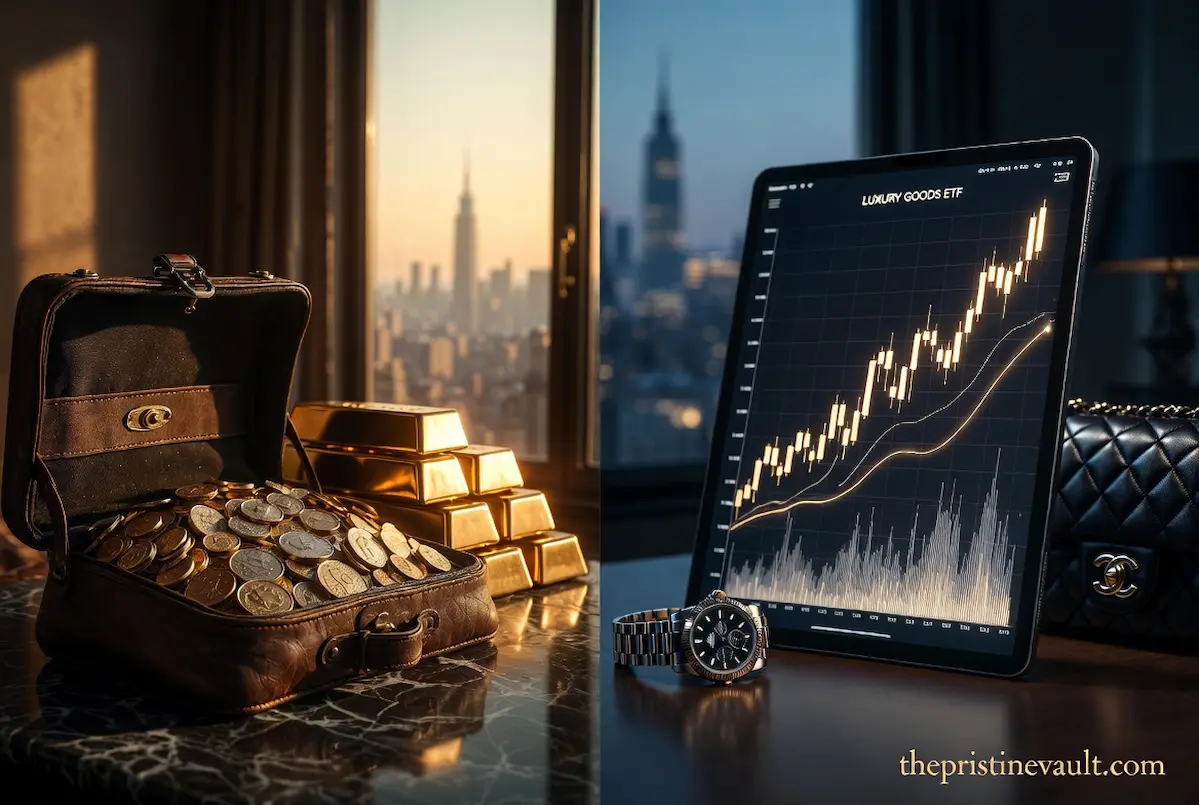
"The luxury goods ETFs vs gold debate reveals something most investors miss entirely — both assets protect wealth, but through fundamentally different mechanisms that perform opposite each other during the economic cycles that matter most."
Gold hit record highs in 2024. Your neighbor keeps talking about it. Meanwhile, LVMH stock quietly returned 300% over the past decade. Your financial advisor never mentioned luxury sector ETFs.
You're sitting on $20,000 earmarked for wealth preservation. Gold feels safe — it's survived thousands of years. But luxury brands keep raising prices while customers line up around the block. Both stories sound compelling.
A collector allocated $10,000 to gold ETFs and $10,000 to the Amundi Luxury ETF in 2019. By 2024, her gold position grew to approximately $14,500. Her luxury ETF position grew to approximately $14,200. Nearly identical returns over five years — but through completely different paths that revealed dramatically different risk profiles.
During the 2022 market correction, her gold position held steady while the luxury ETF dropped 20%. During the 2023 recovery, the luxury ETF surged 30% while gold moved sideways. Same total outcome. Opposite journeys.
This guide compares luxury goods ETFs and gold across seven factors that determine which strategy better serves your wealth preservation goals in 2026 and beyond.
Here's everything you need to know.
Table of Contents
- Luxury Goods ETFs vs Gold: 7 Proven Factors That Reveal Which Wealth Strategy Wins in 2026
- Editor's Picks: Essential Resources for Luxury & Gold Investors
- Quick Comparison: Luxury ETFs vs Gold at a Glance
- Factor 1: Historical Performance Head-to-Head
- Factor 2: How Each Asset Responds to Economic Conditions
- Factor 3: Income Generation — Where Gold Falls Short
- Factor 4: Inflation Protection — Both Work, Differently
- Factor 5: Liquidity and Access
- Factor 6: Portfolio Correlation — Why This Factor Matters Most
- Factor 7: The Optimal 2026 Strategy — Combining Both
- 7 Quick Tips for Luxury ETF and Gold Investors (Most People Skip These)
- Mistakes That Cost Wealth Preservation Investors Thousands
- Frequently Asked Questions
- Conclusion
This post contains affiliate links. We may earn a small commission at no extra cost to you.
Disclaimer: This article is for educational purposes only. It is not financial advice. Always consult a qualified financial advisor before making investment decisions.
Editor's Picks: Essential Resources for Luxury & Gold Investors
Before we dive in, here are the top-rated resources most serious investors trust:
- "The Luxury Strategy" by Kapferer & Bastien — Understanding luxury economics for investment decisions → Check on Amazon
- "The New Case for Gold" by James Rickards — Modern gold investment thesis → Check on Amazon
- "The Intelligent Investor" by Benjamin Graham — Framework for evaluating any asset class → Check on Amazon
(More recommendations throughout the article)
Quick Comparison: Luxury ETFs vs Gold at a Glance
| Factor | Luxury Goods ETFs | Gold (ETFs/Physical) |
|---|---|---|
| 10-Year Return | ~120-180% | ~80-120% |
| Dividend Income | 1-2% annually | 0% (no yield) |
| Recession Performance | Declines 15-30% | Typically rises 10-20% |
| Inflation Hedge | Strong (pricing power) | Strong (traditional hedge) |
| Annual Costs | 0.25-0.75% (ETF fees) | 0.25-0.40% (ETF fees) |
| Liquidity | Excellent | Excellent (ETFs) |
| Correlation to Stocks | High | Low/Negative |
| Crisis Protection | Weak | Strong |
| Growth Potential | High | Moderate |
| Volatility | Higher | Lower |
Quick verdict:
- 🏆 Best for growth: Luxury goods ETFs (stronger long-term appreciation)
- 🛡️ Best for crisis protection: Gold (inverse correlation to market fear)
- ⚖️ Best balanced approach: Both (complementary strategies)
Factor 1: Historical Performance Head-to-Head
Luxury ETF Returns
The Amundi S&P Global Luxury ETF (GLUX) tracks companies like LVMH, Hermès, Richemont, Ferrari, and Kering.
Performance periods:
- 2014-2024 (10 years): ~150-180% total return
- 2019-2024 (5 years): ~35-45% total return
- 2022 drawdown: -22% from peak
- 2023 recovery: +28% from 2022 low
The luxury sector generates returns through two mechanisms: revenue growth from expanding global wealth and margin expansion from consistent price increases.
LVMH alone grew revenue from €30 billion to €86 billion between 2014 and 2023. That's not stock market speculation — it's real business growth from selling Birkin bags, Louis Vuitton trunks, and Dom Pérignon champagne.
For detailed analysis of specific luxury ETF options, our comprehensive luxury brand ETF guide reviews seven funds with fee comparisons.
Gold Returns
Gold's performance reflects fear, inflation expectations, and currency movements rather than business fundamentals.
Performance periods:
- 2014-2024 (10 years): ~80-120% total return
- 2019-2024 (5 years): ~55-75% total return
- 2022 performance: Roughly flat (-1% to +2%)
- 2024 surge: +25-30% (geopolitical uncertainty)
Gold generates zero income. No dividends. No interest. No revenue growth. Returns come exclusively from price appreciation driven by market sentiment and macroeconomic factors.
That said, gold's 2024 surge to record highs demonstrated its crisis-response capability precisely when investors needed stability most.
The Performance Comparison
In bull markets: Luxury ETFs significantly outperform gold. Growing economies increase luxury spending while gold sits idle.
In bear markets and crises: Gold outperforms luxury ETFs. Fear drives gold demand while luxury spending contracts.
Over full market cycles (10-20 years): Performance has been comparable, with luxury ETFs holding a slight edge due to underlying business growth.
The next section covers the mistake most people make at this stage.
Factor 2: How Each Asset Responds to Economic Conditions
Understanding when each asset excels reveals why owning both makes strategic sense.
Luxury ETFs During Different Economies
Strong economy:
- Luxury spending increases with consumer confidence
- LVMH, Hermès, Richemont report revenue growth
- Stock prices appreciate alongside earnings
- ETF returns: Strong (15-25% annually possible)
Moderate economy:
- Luxury spending remains resilient (wealthy consumers less affected)
- Price increases offset volume softness
- ETF returns: Moderate (5-10% annually typical)
Recession:
- Even wealthy consumers reduce discretionary spending
- Luxury company revenues decline 10-20%
- Stock prices fall 15-30%
- ETF returns: Negative
Gold During Different Economies
Strong economy:
- Gold underperforms (investors prefer growth assets)
- Opportunity cost is highest (money in gold misses stock gains)
- Gold returns: Weak (flat to slight decline)
Moderate economy:
- Gold holds value but generates minimal returns
- Functions as portfolio insurance nobody needs
- Gold returns: Modest (2-5% annually)
Recession/Crisis:
- Gold surges as safe haven demand increases
- Central bank buying accelerates
- Currency debasement fears drive prices
- Gold returns: Strong (10-30%+ during major crises)
The Counterbalance Effect
Here's the insight most investors miss in the luxury goods ETFs vs gold debate: these assets move in opposite directions during the periods that matter most.
When luxury ETFs suffer their worst performance (recessions), gold typically delivers its best. When gold sits idle (economic booms), luxury ETFs generate their strongest returns.
Owning both creates a natural portfolio hedge that neither asset provides alone.
A collector held 70% luxury ETFs and 30% gold entering the 2022 market correction. Her luxury position dropped 22%. Her gold position rose 2%. The blended portfolio declined approximately 15% — significantly less painful than pure luxury exposure.
For understanding how physical luxury assets behave during market stress compared to their financial counterparts, our luxury goods vs ETFs analysis covers tangible asset dynamics.
But performance history alone doesn't determine which strategy wins — here's what income generation reveals.
Factor 3: Income Generation — Where Gold Falls Short
Luxury ETF Dividends
Luxury companies generate massive cash flows. LVMH's operating cash flow exceeded €20 billion in 2023. Some of this returns to shareholders as dividends.
Typical luxury ETF dividend yield: 1-2% annually
On a $50,000 investment, that's $500-1,000 per year in dividend income. Not life-changing — but it's real cash that compounds when reinvested.
Additionally, luxury companies conduct share buybacks that reduce outstanding shares and increase per-share value. This hidden return doesn't show in dividend yield but contributes meaningfully to total shareholder returns.
Gold's Zero Income Problem
Gold generates absolutely zero income. No dividends. No interest. No cash flow. Nothing.
A $50,000 gold position sitting for ten years produces exactly $0 in income. The only return comes from selling at a higher price than you bought.
This matters enormously for long-term wealth building. Reinvested dividends from luxury ETFs compound over decades. Gold requires price appreciation alone to generate any return.
The Compounding Difference Over 20 Years
$50,000 in luxury ETF (8% annual return + 1.5% dividend, reinvested):
- Year 10: ~$120,000
- Year 20: ~$290,000
$50,000 in gold (6% annual price appreciation, zero income):
- Year 10: ~$89,500
- Year 20: ~$160,000
The $130,000 gap after 20 years comes primarily from compounding dividends — the income gold structurally cannot provide.
👉 Get "The Intelligent Investor" on Amazon
For comparing specific luxury investment approaches including physical watches versus financial instruments, our Rolex vs ETF analysis covers the tangible versus financial debate.
Up next: the one factor that completely changes this analysis for specific investors.
Factor 4: Inflation Protection — Both Work, Differently
How Luxury ETFs Hedge Inflation
Luxury brands raise prices above inflation consistently. Chanel increased handbag prices 72% between 2019 and 2024. Hermès raises Birkin prices 7-10% annually. Rolex implements 5-8% annual increases.
These price increases flow directly to revenue and profit. When inflation runs at 4%, luxury companies raising prices 8% actually increase real margins.
Luxury ETFs capture this pricing power at the portfolio level. You benefit from the same price increases that luxury consumers pay — except you're on the receiving side as a shareholder.
How Gold Hedges Inflation
Gold has historically maintained purchasing power across centuries. An ounce of gold in 1920 bought a quality men's suit. An ounce of gold today buys a quality men's suit.
During high-inflation periods, gold typically appreciates as investors seek stores of value outside depreciating paper currencies. The 1970s inflation spike saw gold rise from $35 to $850. Recent inflation concerns pushed gold to record highs in 2024.
Gold's inflation hedge is more direct than luxury ETFs — it doesn't depend on corporate execution, consumer spending patterns, or market sentiment about specific companies.
Which Hedge Is Stronger?
During moderate inflation (2-5%):
Luxury ETFs provide stronger returns because corporate earnings growth compounds on top of inflation protection.
During high inflation (5%+):
Gold typically outperforms because extreme inflation damages consumer discretionary spending — including luxury purchases — while gold demand surges from currency-debasement fears.
During deflation:
Neither performs well, but luxury companies with pricing power maintain margins better than gold, which can decline during deflationary periods.
Understanding the craftsmanship and scarcity driving luxury pricing power helps evaluate the sustainability of luxury brands' inflation-beating price increases. Our guide on luxury watch vs fashion watch differences explains value drivers in the luxury market.
The next section covers the mistake most people make at this stage.
Factor 5: Liquidity and Access
Accessing Luxury ETFs
Purchase: Through any brokerage account (Schwab, Fidelity, Vanguard, etc.)
Minimum investment: Price of one share ($50-200 typically)
Selling: Instant during market hours
Settlement: T+1 (cash available next business day)
Fractional shares available at many brokerages allow investment starting at $1.
Accessing Gold
Gold ETFs (GLD, IAU):
- Purchase: Same as any ETF through standard brokerages
- Minimum: Price of one share ($20-200)
- Liquidity: Excellent — instant selling during market hours
Physical gold:
- Purchase: Dealers, online retailers, banks
- Minimum: Varies (small bars start around $2,000)
- Liquidity: Lower — requires finding buyers, authentication, shipping
- Storage: Requires safe deposit box or home safe ($100-500/year)
Liquidity Verdict
Gold ETFs and luxury ETFs are equally liquid through brokerage accounts. Physical gold has the same liquidity challenges as physical luxury goods — but with better price transparency.
For most investors, ETF formats for both luxury and gold eliminate liquidity concerns entirely.
But liquidity doesn't matter if the asset doesn't protect wealth — here's what correlation analysis reveals.
Factor 6: Portfolio Correlation — Why This Factor Matters Most
What Correlation Means for Your Portfolio
Correlation measures how two assets move relative to each other:
- +1.0: Move identically (no diversification benefit)
- 0: No relationship (moderate diversification)
- -1.0: Move opposite (maximum diversification)
Luxury ETFs vs Stock Market
Luxury ETFs have high positive correlation with broad stock markets (+0.7 to +0.85). When stocks decline, luxury ETFs typically decline similarly.
This means owning luxury ETFs alongside an S&P 500 ETF provides limited diversification benefit. Both tend to fall during the same economic conditions.
Gold vs Stock Market
Gold has low to negative correlation with stocks (-0.1 to +0.2). When stocks decline sharply, gold often appreciates.
This makes gold a genuine diversifier — one of the few asset classes that consistently provides portfolio protection during equity market stress.
Gold vs Luxury ETFs
Gold and luxury ETFs have low correlation (+0.1 to +0.3). They serve fundamentally different economic functions and respond to different drivers.
Why This Matters More Than Returns
A portfolio with two uncorrelated assets outperforms either asset individually on a risk-adjusted basis — even if one asset has lower absolute returns.
Example:
- 100% luxury ETF: Higher returns, higher volatility, deeper drawdowns
- 70% luxury ETF + 30% gold: Slightly lower total returns, significantly reduced volatility and drawdowns
The 70/30 blend doesn't maximize returns. It maximizes the returns-per-unit-of-risk ratio. For long-term wealth preservation, this matters more than raw performance numbers.
For protecting physical luxury assets within a diversified wealth strategy, our Rolex Datejust winder guide covers maintenance that preserves tangible luxury investments.
Up next: the practical allocation strategy that combines both approaches.
Factor 7: The Optimal 2026 Strategy — Combining Both
Why Neither Alone Is Optimal
Gold alone:
- Zero income
- Underperforms during growth periods
- Flat-to-declining in strong economies
- Maximum safety but minimum growth
Luxury ETFs alone:
- Significant downside during recessions
- High correlation with broader equity markets
- Strong growth but vulnerability during crises
- Maximum growth but limited crisis protection
The Recommended Allocation Framework
Conservative (wealth preservation priority):
50% Luxury Goods ETF (GLUX or LUXX)
30% Gold ETF (GLD or IAU)
20% Cash / Short-term bonds
Balanced (growth + protection):
25% Gold ETF
15% Cash / Short-term bonds
Aggressive (growth priority):
75% Luxury Goods ETF
15% Gold ETF
10% Cash
Adding Physical Luxury Assets
For collectors who own physical luxury goods (watches, bags, jewelry), factor these into your luxury allocation:
Total luxury exposure = Physical luxury assets (at market value) + Luxury ETF position
Keep total luxury exposure below 30% of net worth regardless of how it's split between physical and financial assets.
👉 Get "The Luxury Strategy" on Amazon
7 Quick Tips for Luxury ETF and Gold Investors (Most People Skip These)
Rebalance between luxury ETFs and gold annually. After strong equity years, luxury ETFs grow disproportionately. Sell some to buy gold, restoring your target ratio.
Use gold for the portion you might need during crises. Gold's crisis performance means it's available when you need stability most. Luxury ETFs provide growth during normal times.
Don't chase gold after major price surges. Gold often pulls back after sharp rises. Buy during quiet periods for better entry points.
Monitor Chinese luxury spending as a leading indicator. Chinese consumers drive 30-35% of global luxury purchases. Weakness in Chinese spending precedes luxury ETF declines.
Consider gold as insurance, not investment. Reframe gold from "this should make me money" to "this protects me when everything else falls." The expectation shift prevents disappointment during gold's inevitable flat periods.
Reinvest luxury ETF dividends automatically. Dividend reinvestment (DRIP) compounds returns without manual intervention. This advantage over gold's zero income grows exponentially over decades.
Track both positions quarterly, not daily. Weekly or daily monitoring creates anxiety-driven trading. Quarterly assessment allows meaningful trend evaluation without emotional interference.
⚠️ Pro Tip: During periods when luxury ETFs decline 15%+ (market corrections), resist the urge to sell luxury and buy gold. This is exactly when gold has likely already risen, making it expensive. Instead, maintain your target allocation — the rebalancing mechanism handles the math for you.
👉 Get "The New Case for Gold" on Amazon
Mistakes That Cost Wealth Preservation Investors Thousands
These common errors undermine both luxury ETF and gold strategies:
Going all-in on gold during market fear. Panic-buying gold at crisis peaks means buying at the highest prices. By the time fear subsides, gold often pulls back while the equity assets you abandoned recover.
Ignoring luxury ETF fees when comparing to gold ETFs. Luxury ETFs charge 0.25-0.75% annually. Gold ETFs charge 0.25-0.40%. Over 20 years, the fee difference compounds to thousands of dollars. Always compare net-of-fee returns.
Treating gold and luxury ETFs as interchangeable. They serve opposite functions in a portfolio. Gold provides crisis insurance. Luxury ETFs provide growth. Substituting one for the other eliminates the diversification benefit that makes combining them powerful.
Buying physical gold for investment purposes. Physical gold carries storage costs, insurance requirements, authentication challenges, and liquidity friction. Gold ETFs provide identical price exposure without these costs. Save physical ownership for collectors, not investors.
Neglecting to rebalance after major market moves. After a 30% luxury ETF gain, your portfolio drifts toward higher luxury allocation. Without rebalancing, you lose the protective balance that combining these assets creates.
Frequently Asked Questions
Are luxury goods ETFs safer than gold?
Neither is inherently "safer." Luxury ETFs carry higher short-term volatility but generate income and long-term growth. Gold carries lower volatility but generates zero income and depends entirely on price appreciation. Combined, they provide better risk-adjusted returns than either alone.
Which luxury ETFs have the best returns?
Amundi S&P Global Luxury (GLUX) and Roundhill S&P Global Luxury (LUXX) have delivered the strongest returns among pure luxury ETFs. For detailed fund comparisons including fees and holdings, see our complete luxury brand ETF guide.
Should I own physical gold or gold ETFs?
For investment purposes, gold ETFs (GLD, IAU) provide identical price exposure with lower costs and better liquidity. Physical gold makes sense for emergency preparedness (accessible during banking crises) but not for standard portfolio allocation. Gold ETFs also avoid storage and insurance costs.
How much should I allocate to gold vs luxury ETFs?
For balanced wealth preservation, 60-70% in luxury ETFs and 25-30% in gold provides strong growth with meaningful crisis protection. Conservative investors may prefer 50/30 luxury-to-gold. Aggressive investors might use 75/15. Adjust based on your risk tolerance and timeline.
Do luxury ETFs pay dividends?
Yes, typically 1-2% annually. Luxury companies like LVMH and Richemont pay regular dividends from strong cash flows. Gold provides zero income. This dividend advantage compounds significantly over long holding periods.
What happens to luxury ETFs during a recession?
Luxury ETFs typically decline 15-30% during recessions as consumer discretionary spending contracts. Recovery usually occurs within 12-18 months as wealthy consumers resume spending. Gold often appreciates during these same periods, providing portfolio counterbalance. For comparing physical luxury assets during downturns, see our luxury goods vs ETFs analysis.
Is gold still relevant as an investment in 2026?
Yes. Gold's record highs in 2024 demonstrate continued relevance during geopolitical uncertainty, inflation concerns, and central bank diversification away from dollar reserves. Gold's role as crisis insurance hasn't diminished despite the availability of modern investment alternatives.
Conclusion
The luxury goods ETFs vs gold comparison reveals three clear principles: luxury ETFs provide superior growth through corporate earnings and dividend income during stable economic periods. Gold provides superior protection during crises and geopolitical uncertainty. Combining both creates a diversified wealth preservation strategy that neither achieves alone.
Neither asset wins in all conditions. Luxury ETFs shine during economic expansion. Gold shines during contraction and fear. Owning both ensures you're always partially positioned for whatever comes next.
The optimal 2026 strategy allocates 60-70% to luxury sector ETFs for growth and dividends, 25-30% to gold for crisis insurance, and maintains a cash buffer for opportunistic buying during market dislocations.
👉 Get "The Intelligent Investor" on Amazon
Now it's your turn — evaluate your current portfolio's balance between growth assets and crisis protection this week. Your wealth preservation strategy will thank you for the honest assessment.