Luxury Goods vs ETFs: 6 Proven Factors That Reveal the Better Store of Value
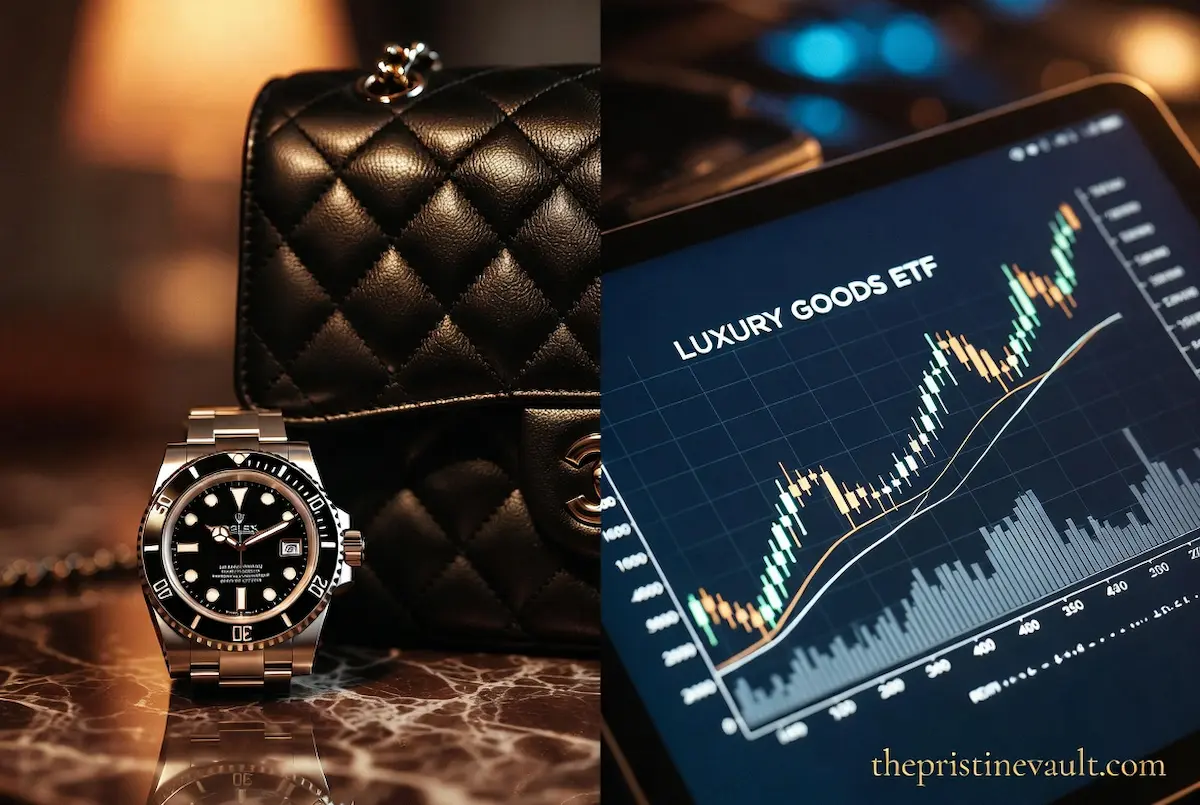
"The luxury goods vs ETFs debate isn't really about which makes more money — it's about understanding that a Birkin bag and a brokerage account protect wealth through entirely different mechanisms, and choosing wrong for your situation costs you either way."
Your closet contains $45,000 worth of designer bags and watches. Your brokerage account holds $45,000 in index funds.
Both represent wealth. Both fluctuate in value. But when you needed emergency cash last year, only one converted to dollars within 24 hours.
A collector I know owned a $28,000 Hermès Kelly bag and a $28,000 S&P 500 position. During a financial emergency, she sold the ETF shares in seconds through her brokerage app. The Kelly took six weeks to sell through consignment — and ultimately sold for $22,000 after fees and negotiation.
Same initial investment. Same moment of need. Dramatically different outcomes.
Meanwhile, another collector's 2017 Chanel Classic Flap appreciated from $4,900 to $10,800 by 2024 — a 120% return that crushed the S&P 500's roughly 90% return over the same period. Her bag outperformed Wall Street while sitting in her closet.
Both stories are true. Both are incomplete without context.
This guide compares luxury goods and ETFs across six critical factors that determine which actually preserves and grows wealth more effectively. You'll learn where each excels, where each fails, and how to combine both for a strategy that captures the advantages of each.
Here's everything you need to know.
Table of Contents
- Luxury Goods vs ETFs: 6 Proven Factors That Reveal the Better Store of Value
- Editor's Picks: Essential Resources for Luxury Investors
- Factor 1: Historical Returns — What the Numbers Actually Show
- Factor 2: The True Cost Nobody Talks About
- Factor 3: Liquidity — When You Need Your Money Back
- Factor 4: The Enjoyment Factor — Value Beyond Numbers
- Factor 5: Risk Analysis — What Can Go Wrong
- Factor 6: The Hybrid Approach — Why Smart Collectors Do Both
- 7 Quick Tips for Balancing Luxury Goods and ETFs (Most Investors Skip These)
- Mistakes That Destroy Luxury Investment Returns
- Frequently Asked Questions
- Are luxury goods better investments than stocks?
- What luxury goods appreciate the most?
- How much of my portfolio should be in luxury goods?
- Do luxury goods protect against inflation?
- Can I include luxury goods in my retirement portfolio?
- What's the best way to start investing in luxury goods?
- Should I sell my luxury goods and invest in ETFs instead?
- Conclusion
This post contains affiliate links. We may earn a small commission at no extra cost to you.
Disclaimer: This article is for educational purposes only. It is not financial advice. Always consult a qualified financial advisor before making investment decisions.
Editor's Picks: Essential Resources for Luxury Investors
Before we dive in, here are the top-rated resources most luxury collectors and investors trust:
- "The Luxury Strategy" by Kapferer & Bastien — Understanding luxury economics from an investment perspective → Check on Amazon
- Wolf Heritage Watch Box — Protecting physical luxury investments that preserve value → Check on Amazon
- "The Intelligent Investor" by Benjamin Graham — Foundational investment framework for any asset class → Check on Amazon
(More recommendations throughout the article)
Factor 1: Historical Returns — What the Numbers Actually Show
Luxury Goods Appreciation
Certain luxury items have generated extraordinary returns over the past decade.
Top performers (approximate appreciation):
| Item | 2015 Price | 2024 Value | Return |
|---|---|---|---|
| Hermès Birkin 25 (Togo) | $9,350 | $14,000-16,000 | +50-71% |
| Chanel Classic Flap Medium | $4,900 | $10,800 | +120% |
| Rolex Daytona 116500LN | $13,150 | $28,000-32,000 | +113-143% |
| Patek Philippe Nautilus 5711 | $29,500 | $120,000+ | +300%+ |
| Cartier Tank Française (vintage) | $3,000 | $8,000-12,000 | +166-300% |
These numbers are genuinely impressive. However, they represent the best-performing items in the most desirable categories. They're the luxury equivalent of showing Tesla's stock return and claiming it represents "stock market performance."
What Doesn't Appreciate
Items that typically depreciate from retail:
- Most Louis Vuitton bags (10-30% depreciation)
- Standard Rolex Datejust and Oyster Perpetual references
- Most designer clothing (60-80% depreciation immediately)
- Luxury sunglasses and accessories (50-70% depreciation)
- Contemporary jewelry without significant gemstones
- Any luxury item that's mass-produced relative to demand
The luxury investment landscape is selective. Roughly 10-15% of luxury purchases appreciate. The rest depreciate — some dramatically.
ETF Historical Returns
Broad market and luxury ETFs (approximate 10-year returns):
| Fund Type | 10-Year Return | Annual Average |
|---|---|---|
| S&P 500 ETF (SPY) | ~180-220% | ~11-12% |
| Luxury Sector ETF (GLUX) | ~120-160% | ~8-10% |
| Total Bond Market ETF | ~15-25% | ~1.5-2.5% |
| Global Diversified ETF | ~100-140% | ~7-9% |
ETF returns are more consistent and predictable than luxury goods appreciation. They also apply to your entire investment — not just the fortunate pieces that happened to appreciate.
For detailed comparison between watches and financial instruments specifically, our comprehensive Rolex vs ETF analysis covers the watch investment debate.
The next section covers the mistake most people make at this stage.
Factor 2: The True Cost Nobody Talks About
Hidden Costs of Luxury Goods as Investments
Storage and protection:
- Quality watch box: $200-600
- Bag storage supplies (dust bags, stuffing, climate control): $50-200/year
- Safe or secure storage: $200-500 initially + ongoing costs
Insurance:
- Jewelry/watch insurance: 1-2% of value annually
- Valuable articles policy: $150-500/year depending on collection value
- Appraisal fees: $50-200 per item every 3-5 years
Maintenance:
- Watch service: $500-1,500 every 5-10 years per watch
- Bag conditioning and cleaning: $50-200/year for supplies
- Professional restoration when needed: $200-800 per incident
Transaction costs:
- Consignment fees: 15-30% of sale price
- Authentication: $50-200 per item
- Shipping and insurance for sales: $50-150 per transaction
For maintaining luxury watches that retain maximum value, proper care equipment matters. Quality winder settings prevent movement damage between wearing — see our Rolex Datejust winder guide for exact specifications.
Hidden Costs of ETF Investments
Management fees:
- Index ETFs: 0.03-0.25% annually
- Luxury sector ETFs: 0.25-0.75% annually
- On a $50,000 investment: $15-375/year
Tax implications:
- Capital gains: 15-20% (long-term) to 37% (short-term) of profits
- Dividend taxes: Annual tax on distributed income
- Tax-loss harvesting partially offsets gains
Brokerage costs:
- Most modern platforms: $0 per trade
- International ETF trading: $0-15 per trade
The Real Cost Comparison
Annual cost of maintaining a $50,000 luxury collection:
Insurance: $500-1,000
Storage supplies: $100-300
Maintenance: $200-500
Total: $800-1,800/year
(1.6-3.6% of value)
Annual cost of maintaining $50,000 in luxury ETFs:
Management fees: $125-375
Tax preparation: $0-50
Total: $125-425/year (0.25-0.85% of value)
Luxury goods cost approximately 3-4x more to maintain as investments than ETFs. Your luxury collection needs to outperform ETFs by 1-3% annually just to break even on carrying costs.
But cost analysis alone misses the factor that changes everything — here's what liquidity reveals.
Factor 3: Liquidity — When You Need Your Money Back
Converting Luxury Goods to Cash
Bags:
- Consignment (The RealReal, Vestiaire Collective): 2-8 weeks, 15-30% fees
- Private sale: 1-4 weeks, best price but buyer verification burden
- Instant buyout services: Same week, 40-50% below market value
Watches:
- Dealer trade-in: Same day, 20-40% below market
- Online marketplace: 1-4 weeks, 5-15% fees
- Auction: 2-3 months, 10-20% fees but potentially highest price
Jewelry:
- Dealer buyback: Same day, 30-50% below retail
- Auction: 2-3 months
- Private sale: Weeks to months
Converting ETFs to Cash
- Market order: Seconds during trading hours
- Limit order: Hours to days depending on price target
- Cash in brokerage account: Same day (T+1 settlement)
- Transfer to bank: 1-3 business days
The Liquidity Verdict
ETFs win overwhelmingly. You convert to cash in seconds at transparent market prices with minimal transaction costs.
Luxury goods require weeks to months for optimal sale price. Selling under time pressure means accepting 20-50% discounts. This liquidity premium alone makes luxury goods unsuitable as emergency reserves.
However, luxury goods provide one liquidity advantage: they function as a store of value during extreme scenarios (currency collapse, banking crises) when electronic financial assets become temporarily inaccessible.
For understanding what makes specific luxury items retain value during market stress, our guide on luxury vs fashion watch differences explains the quality factors driving resilience.
Up next: the one advantage luxury goods have that ETFs can never match.
Factor 4: The Enjoyment Factor — Value Beyond Numbers
What ETFs Can't Provide
An ETF sits in your brokerage account. You check numbers on a screen. You feel satisfied when they're up. You feel anxious when they're down. But you never wear your ETF to dinner.
A Chanel Classic Flap accompanies you to events, business meetings, and family celebrations. A Rolex Submariner marks career milestones, anniversaries, and daily reminders of what you've accomplished.
This "enjoyment premium" is real wealth — just unmeasurable.
A collector told me she wore her grandmother's Cartier Tank watch daily for thirty years. The watch appreciated from $3,000 to $12,000 during that period. But the memories — wearing it at her wedding, her children's graduations, international travels — represented value that no brokerage statement captures.
The Emotional Liability
That said, emotional attachment to luxury goods creates investment blind spots.
Emotional attachment causes owners to:
- Hold depreciating items because of sentimental value
- Reject fair offers because "the piece is worth more to me"
- Avoid necessary maintenance that preserves value
- Make purchase decisions based on desire rather than investment analysis
ETFs carry zero emotional attachment. Selling is a rational financial decision without sentiment. This emotional neutrality is genuinely advantageous for wealth preservation.
The Honest Assessment
If your luxury collection brings daily joy, the enjoyment premium has real economic value — it replaces spending on other forms of entertainment and personal satisfaction.
If your luxury goods sit in storage appreciating on paper but never used, you're accepting the higher costs and lower liquidity of physical assets without capturing the enjoyment benefit that justifies them.
For ensuring physical luxury assets that provide enjoyment also maintain investment value, proper maintenance is critical. Recognizing signs your automatic watch needs servicing prevents deferred maintenance that reduces both enjoyment and resale value.
The next section covers the mistake most people make at this stage.
Factor 5: Risk Analysis — What Can Go Wrong
Luxury Goods Risks
Physical risks:
- Theft (concentrated in single, steal able items)
- Damage (accidents, improper storage, natural disasters)
- Loss (travel mishaps, misplacement)
Market risks:
- Brand perception changes (Gucci's recent sales decline)
- Trend cycles devaluing specific styles
- Counterfeit market undermining authentication confidence
- Economic downturns reducing luxury secondary market demand
Condition risks:
- Improper storage causing material deterioration
- Deferred maintenance reducing value
- Professional repair altering original condition
ETF Risks
Market risks:
- Sector downturns (luxury ETFs declined 15-25% in 2022)
- Broader market crashes affecting all equity investments
- Currency fluctuations for international ETFs
Structural risks:
- Fund closure (rare but possible for niche ETFs)
- Tracking error (fund underperforming its benchmark index)
- Tax law changes affecting investment returns
Risk Comparison
| Risk Type | Luxury Goods | ETFs |
|---|---|---|
| Total loss possibility | Low-moderate (theft, destruction) | Very low (diversified) |
| Partial loss (20-30%) | Common (market timing, condition) | Moderate (market corrections) |
| Liquidity risk | High | Very low |
| Counterparty risk | Moderate (authentication, buyer trust) | Low (regulated markets) |
| Emotional decision risk | High | Low |
| Inflation hedge | Strong (luxury prices rise with inflation) | Moderate (depends on sector) |
| Currency crisis hedge | Strong (tangible asset) | Weak (digital, market-dependent) |
For a focused comparison on watch investments specifically, our luxury brand ETF guide covers how ETFs capture luxury sector returns without physical asset risks.
But understanding risks is only half the equation — here's what the optimal strategy actually looks like.
Factor 6: The Hybrid Approach — Why Smart Collectors Do Both
The Optimal Allocation Framework
Pure luxury goods investment = too illiquid, too costly to maintain, too emotionally driven.
Pure ETF investment = no tangible enjoyment, no inflation hedge from physical assets, no unique appreciation potential.
The smart approach combines both:
Tier 1: Core Financial Portfolio (60-75%)
Diversified ETFs provide the foundation:
- Broad market ETF (S&P 500 or Total Market): 40-50%
- International ETF: 10-15%
- Luxury sector ETF: 5-10% (captures luxury industry growth)
This tier handles: consistent returns, liquidity needs, retirement planning, emergency reserves.
Tier 2: Physical Luxury Assets (15-25%)
Strategic luxury purchases that combine enjoyment with value retention:
- 1-2 investment-grade watches (Rolex, Patek Philippe)
- 1-2 appreciating handbags (Hermès, select Chanel)
- Fine jewelry with significant gemstone value
This tier handles: enjoyment premium, inflation hedging, tangible asset diversification, generational wealth transfer.
Tier 3: Cash and Bonds (10-15%)
Stability and immediate liquidity:
- High-yield savings
- Short-term bonds
- Emergency fund
This tier handles: immediate liquidity needs, market downturn buying opportunities, peace of mind.
How to Size Each Tier
Calculate your total luxury asset value (current market value, not what you paid):
- All watches at secondary market value
- All bags at current resale value
- All jewelry at appraised value
Compare to total net worth:
- Luxury assets under 15% of net worth → Room to acquire more strategic pieces
- Luxury assets at 15-25% → Balanced allocation, maintain current level
- Luxury assets above 25% → Consider selling non-appreciating pieces and redirecting to ETFs
👉 Get "The Luxury Strategy" on Amazon
7 Quick Tips for Balancing Luxury Goods and ETFs (Most Investors Skip These)
Buy luxury you'll use, invest in ETFs for what you won't. A $10,000 watch you wear daily provides more value than $10,000 in a watch you store hoping it appreciates.
Track luxury assets on a spreadsheet alongside your portfolio. Most investors know their ETF values daily but guess at their luxury collection's worth. Track both with equal rigor.
Set a luxury spending cap tied to net worth. Commit to keeping physical luxury assets below 20-25% of total net worth. When tempted by a new purchase, check the ratio first.
Maintain luxury assets like they're investment properties. Storage, insurance, and maintenance aren't optional costs — they're the price of preserving your investment. Neglected luxury goods depreciate faster than maintained ones.
Sell underperforming luxury pieces and redirect to ETFs. That $3,000 bag that's now worth $1,500 isn't recovering. Sell, reinvest in a luxury ETF, and let the proceeds grow where they have a better chance.
Rebalance annually. If your Rolex appreciated 30% while ETFs returned 10%, your luxury allocation has grown disproportionately. Consider whether rebalancing is appropriate.
Document everything. Receipts, appraisals, condition photos, service records. Documentation protects insurance claims, supports resale pricing, and provides tax basis evidence.
⚠️ Pro Tip: Treat luxury purchases above $5,000 with the same due diligence you'd apply to any investment decision. Research appreciation history, verify authenticity, assess condition thoroughly, and calculate total cost of ownership before buying. Impulse luxury purchases are consumption, not investment.
👉 Get Wolf Heritage Watch Box on Amazon
Mistakes That Destroy Luxury Investment Returns
These common errors cost collectors and investors thousands:
Calling every luxury purchase an "investment." Most luxury goods depreciate. Calling consumption "investing" prevents honest financial assessment. Be clear about which purchases are for enjoyment and which have genuine appreciation potential.
Neglecting maintenance on luxury assets. A $15,000 Rolex without regular service loses $2,000-3,000 in resale value. A $10,000 Hermès bag stored improperly loses $3,000-5,000 from condition deterioration. Maintenance costs are investment protection, not optional expenses.
Over-concentrating in luxury during strong markets. When Rolex prices peaked in 2022, some collectors had 40-50% of net worth in watches. The subsequent 20-30% correction caused significant paper losses. Diversification isn't optional — it's essential.
Ignoring carrying costs in return calculations. A luxury item that "appreciated 30% over five years" but cost $5,000 in insurance, storage, and maintenance actually returned approximately 15-20%. Always calculate net returns.
Treating luxury ETFs as a substitute for physical luxury ownership. ETFs provide financial exposure to the luxury sector. They don't provide the enjoyment, cultural significance, or tangible value that physical luxury ownership offers. They serve different purposes within a portfolio.
Frequently Asked Questions
Are luxury goods better investments than stocks?
Specific luxury items (select Rolex, Hermès, Patek Philippe) have outperformed stock market indices during certain periods. However, stocks and ETFs provide more consistent, liquid, and diversified returns over long periods. Most luxury goods depreciate. The answer depends entirely on which specific items and which time period you're comparing.
What luxury goods appreciate the most?
Hermès Birkin and Kelly bags, discontinued Rolex sport watches, Patek Philippe Nautilus and Aquanaut, rare vintage jewelry, and limited-edition pieces with documented provenance consistently demonstrate the strongest appreciation. Common factors: brand prestige, production scarcity, and cultural significance. For understanding luxury product quality factors, see our luxury watch anatomy guide.
How much of my portfolio should be in luxury goods?
Financial advisors generally recommend keeping physical luxury assets below 15-25% of total net worth. Higher allocations create liquidity risk and concentration risk. The optimal percentage depends on your liquidity needs, total net worth, and how actively you enjoy your luxury collection.
Do luxury goods protect against inflation?
Yes — certain luxury goods provide strong inflation hedging. Luxury brands raise prices consistently above inflation rates. Hermès and Chanel increase handbag prices 7-12% annually. A bag purchased five years ago at lower prices has captured this inflation protection. ETFs also provide inflation protection through corporate earnings growth, but luxury goods offer more direct pricing-power exposure.
Can I include luxury goods in my retirement portfolio?
Technically, self-directed IRAs can hold certain physical assets, but luxury goods aren't standard retirement account holdings. For retirement planning, ETFs provide more appropriate liquidity, diversification, and professional management. Consider luxury goods as a supplement to — not replacement for — traditional retirement investments.
What's the best way to start investing in luxury goods?
Start with a single high-quality piece from a brand with proven appreciation history (Rolex, Hermès, Patek Philippe). Buy at retail from authorized dealers. Maintain complete documentation. Invest in proper storage and insurance. Monitor secondary market values annually. For comparing luxury investment approaches, see our complete Rolex vs ETF analysis.
Should I sell my luxury goods and invest in ETFs instead?
Not necessarily. Appreciating items worth keeping include pieces with strong brand provenance, documented condition, and genuine enjoyment value. Sell items that have depreciated significantly, provide no enjoyment, and carry ongoing insurance and storage costs without appreciation potential. Redirect proceeds to diversified investments including luxury sector ETFs.
Conclusion
The luxury goods vs ETFs debate resolves into three clear principles: ETFs provide superior liquidity, consistency, and cost efficiency for wealth building. Luxury goods provide tangible enjoyment, inflation hedging, and unique appreciation potential for select items. The optimal strategy combines both — financial portfolio for core wealth, physical luxury for enjoyment and diversification.
Neither approach works optimally alone. Pure luxury investment is too illiquid and costly. Pure ETF investment misses the tangible value and cultural significance that luxury ownership provides.
Build your financial foundation with diversified ETFs. Add strategic luxury purchases that combine personal enjoyment with genuine appreciation potential. Maintain both with the same discipline. That hybrid approach captures advantages no single strategy can deliver.
👉 Get "The Intelligent Investor" on Amazon
Now it's your turn — calculate your current luxury-to-financial asset ratio this weekend and assess whether rebalancing strengthens your overall wealth preservation strategy. Your financial future will thank you for the honest assessment.