Rolex vs Luxury ETF: 5 Proven Factors That Determine Which Preserves Wealth Better
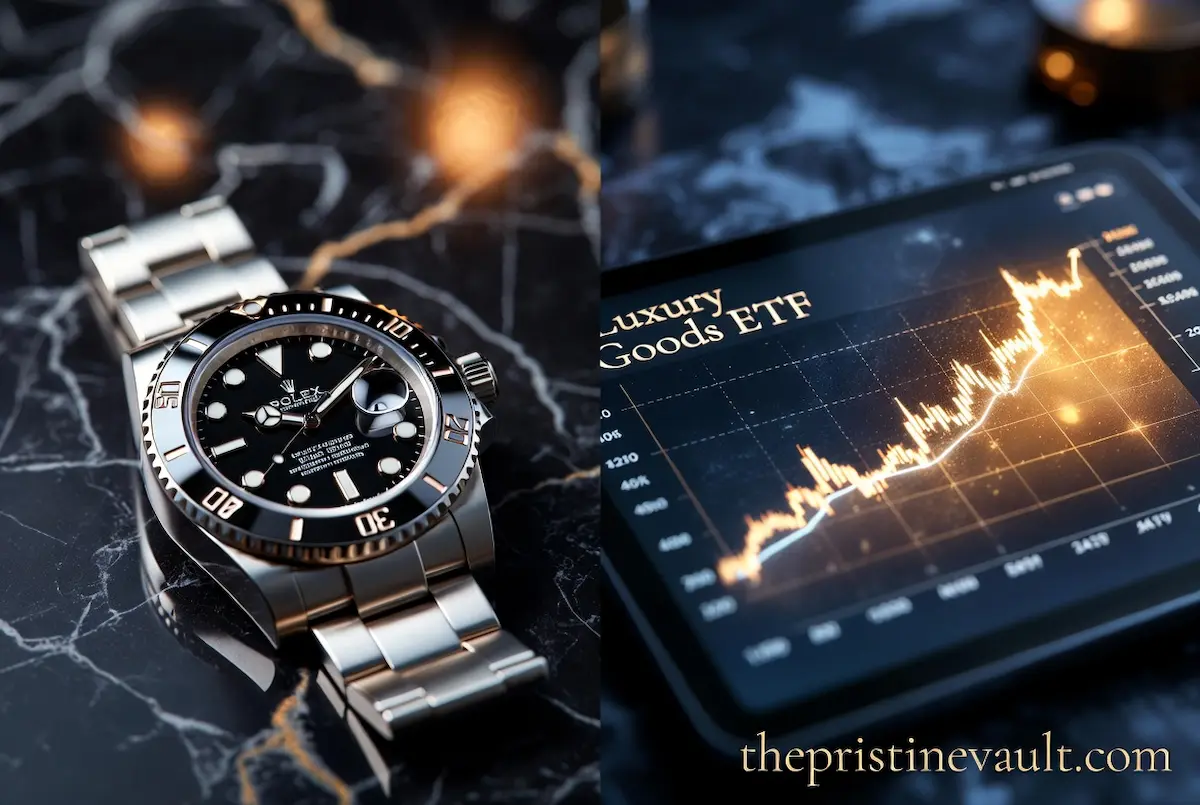
"The Rolex vs ETF investment debate isn't about which makes more money — it's about understanding that one sits on your wrist while the other sits in a brokerage account, and that distinction changes everything about how they perform."
Your financial advisor says invest in index funds. Your watch dealer says buy a Submariner before prices increase again. Your friend claims his Rolex Daytona appreciated 40% in three years. Your other friend points out the S&P 500 returned 26% last year.
Who's right?
A collector bought a steel Rolex GMT-Master II "Pepsi" at retail ($10,500) in 2019. By 2022, the secondary market valued it at $24,000. He felt like a genius. By late 2023, that same watch dropped to $16,000. Still profitable — but the trajectory changed his perspective entirely.
Meanwhile, $10,500 invested in a broad luxury goods ETF in 2019 grew to approximately $14,200 by 2023 — less dramatic upside, but without the anxiety of watching secondary market prices fluctuate weekly.
Both approaches have merit. Both have serious limitations most advocates conveniently ignore.
This guide compares Rolex watches and luxury-focused ETFs across five critical factors that determine long-term wealth preservation. You'll learn which investment strategy matches different financial situations, risk tolerances, and lifestyle preferences.
Here's everything you need to know.
Table of Contents
- Editor's Picks: Essential Products for Protecting Your Rolex Investment
- Factor 1: Historical Returns — The Numbers Don't Lie (But They Don't Tell the Whole Story)
- Factor 2: True Cost of Ownership
- Factor 3: Liquidity — Getting Your Money Back
- Factor 4: The Enjoyment Premium — What ETFs Can't Provide
- Factor 5: Risk Profile — What Can Go Wrong
- 7 Quick Tips for Rolex Investment Decisions (Most Collectors Miss These)
- Mistakes That Cost Rolex Investors Thousands
- Frequently Asked Questions
- Is a Rolex a better investment than stocks?
- Which Rolex models are the best investments?
- How much does a Rolex appreciate per year?
- What are luxury ETFs?
- Can I lose money on a Rolex?
- Should I insure my Rolex if I'm treating it as an investment?
- Is it better to buy one expensive Rolex or diversify into an ETF?
- Conclusion
This post contains affiliate links. We may earn a small commission at no extra cost to you.
Editor's Picks: Essential Products for Protecting Your Rolex Investment
Before we dive in, here are the top-rated products most Rolex investors trust for preserving their watch's value:
- Wolf Heritage Watch Box — Professional storage that maintains Rolex condition and resale value → Check on Amazon
- Rechargeable Silica Gel Canister — Humidity control that prevents moisture damage to movements → Check on Amazon
- Selvyt Polishing Cloth — Safe surface cleaning between professional services → Check on Amazon
(More recommendations throughout the article)
Factor 1: Historical Returns — The Numbers Don't Lie (But They Don't Tell the Whole Story)
Rolex Price Appreciation
Certain Rolex references have appreciated dramatically over the past decade.
Notable performers (retail to 2024 secondary market):
- Daytona 116500LN: $13,150 → $28,000-32,000 (+115-143%)
- GMT-Master II 126710BLRO "Pepsi": $9,700 → $17,000-19,000 (+75-96%)
- Submariner 124060 (no-date): $8,100 → $11,500-13,000 (+42-60%)
- Explorer 124270: $6,550 → $8,500-9,500 (+30-45%)
These numbers look impressive. However, they represent specific references during a specific period. Not every Rolex appreciates. Many Datejust and Oyster Perpetual references sell below retail on the secondary market.
Luxury ETF Performance
The Amundi S&P Global Luxury ETF and similar luxury-sector funds track companies like LVMH, Hermès, Richemont (Cartier parent), and Kering (Gucci parent).
Historical returns (approximate, 5-year periods):
- 2019-2024: ~35-45% total return
- 2014-2019: ~55-70% total return
- 2009-2014: ~120-150% total return (post-financial crisis recovery)
ETF returns are diversified across multiple luxury companies. No single-stock concentration risk. However, luxury ETFs also declined 15-25% during 2022's market correction before recovering.
The Honest Comparison
Rolex advantages:
- Select references outperform ETFs significantly
- Tangible asset you can wear and enjoy
- No annual management fees eroding returns
ETF advantages:
- Consistent long-term appreciation across market cycles
- Dividend income (many luxury companies pay dividends)
- No storage, insurance, or maintenance costs
To understand what makes specific Rolex models valuable investments, our guide on anatomy of a luxury watch explains the craftsmanship factors driving appreciation.
The next section covers the mistake most people make at this stage.
Factor 2: True Cost of Ownership
The sticker price is where most Rolex vs ETF investment comparisons begin and end. But true cost of ownership tells a different story.
Hidden Costs of Rolex Ownership
Service costs: Rolex recommends full movement service every 10 years. Cost: $600-1,200 per service. For a 30-year holding period, that's $1,800-3,600 in maintenance.
Insurance: Annual premium for a $15,000 watch runs approximately $150-300/year. Over 10 years: $1,500-3,000.
Storage: Proper watch storage (quality box, humidity control, winder) costs $200-500 initially plus ongoing supplies.
Opportunity cost: The money sitting on your wrist isn't compounding in the market. A $15,000 Rolex held for 10 years at 0% return versus $15,000 in an ETF returning 8% annually means forgoing approximately $17,400 in potential gains.
For maintaining Rolex watches that preserve maximum resale value, proper winder settings prevent movement wear. Our guide on Rolex winder settings covers exact specifications.
Hidden Costs of ETF Ownership
Management fees: Luxury ETFs charge 0.25-0.60% annually. On a $15,000 investment, that's $37.50-90 per year.
Tax implications: Capital gains tax applies when you sell. Depending on holding period and jurisdiction, this can be 15-37% of profits.
Brokerage fees: Minimal with modern platforms ($0-10 per trade).
The Real Cost Difference
Over a 10-year holding period with a $15,000 initial investment:
| Cost Category | Rolex | Luxury ETF |
|---|---|---|
| Purchase price | $15,000 | $15,000 |
| Ongoing maintenance | $600-1,200 | $0 |
| Insurance (10yr) | $1,500-3,000 | $0 |
| Storage/tools | $200-500 | $0 |
| Management fees (10yr) | $0 | $375-900 |
| Transaction costs | $0-500 (dealer spread) | $0-20 |
| Total cost of ownership | $17,300-20,200 | $15,375-15,920 |
The Rolex needs to appreciate approximately $2,000-4,300 just to break even with the ETF on a cost basis — before comparing actual investment returns.
👉 Get Watch Tools Documentation Kit on Amazon
But cost analysis alone misses a crucial factor — here's what liquidity reveals.
Factor 3: Liquidity — Getting Your Money Back
Selling a Rolex
Timeline: Days to weeks depending on model demand
Methods:
- Authorized dealer (consignment): 4-8 weeks, 15-25% commission
- Private sale: 1-7 days, best price but buyer verification burden
- Online marketplace (Chrono24, Watch Box): 1-4 weeks, 5-15% fees
- Local dealer (walk-in): Same day, lowest price (often 30-40% below market)
Challenges:
- Authentication required (costs $50-200)
- Condition directly affects price (scratches, service history matter)
- Market timing matters — secondary Rolex prices fluctuate significantly
- No guaranteed buyer at your asking price
For maintaining condition that maximizes resale, knowing the signs your automatic watch needs servicing prevents deferred maintenance that reduces sale price.
Selling ETF Shares
Timeline: Seconds to minutes during market hours
Methods:
- Brokerage sell order: Executed within seconds at market price
- Limit orders: Executed when price reaches your target
Challenges:
- Market must be open (weekdays only)
- Capital gains tax triggered upon sale
- Market price may be unfavorable at time of need
The Liquidity Verdict
ETFs win decisively on liquidity. You can convert to cash in seconds at transparent market prices. Rolex liquidation takes days to weeks and involves negotiation, authentication, and significant price uncertainty.
For emergencies requiring fast cash, ETFs provide instant access. Selling a Rolex under time pressure almost always means accepting below-market prices.
Up next: the one factor that changes everything about this comparison.
Factor 4: The Enjoyment Premium — What ETFs Can't Provide
Here's where Rolex gains an advantage no financial instrument can match.
You Can Wear Your Investment
An ETF sits in a brokerage account. You never touch it. Never feel it. Never receive compliments on it. It's numbers on a screen.
A Rolex sits on your wrist. You wear it to meetings. Hand it to your child at graduation. Pass it to your grandchild with a story attached.
The "enjoyment premium" is impossible to quantify financially. But it's real. A collector wearing a GMT-Master II across 30 years of travel, business meetings, and family milestones experiences value that portfolio charts can't capture.
Emotional Attachment Has Financial Implications
That said, emotional attachment creates financial blind spots. Collectors hold depreciating references because they "love the watch." They decline fair offers because the piece has sentimental value exceeding market value.
ETFs carry no emotional attachment. You sell when the numbers justify selling. Clean, rational, unemotional.
Understanding what makes certain watches worth their premium helps separate emotional purchases from strategic ones. Our guide on luxury watch vs fashion watch differences explains value indicators.
The Honest Assessment
If you value tangible enjoyment alongside financial returns, Rolex provides something ETFs fundamentally cannot. If you approach investing purely as wealth accumulation, ETFs deliver cleaner, more predictable returns without emotional complications.
The next section covers the mistake most people make at this stage.
Factor 5: Risk Profile — What Can Go Wrong
Rolex-Specific Risks
Market bubble burst: Secondary Rolex prices dropped 20-30% from 2022 peaks. Some references haven't recovered. Market speculation inflates and deflates unpredictably.
Theft and damage: Physical assets can be stolen, damaged, or destroyed. Insurance covers replacement cost but can't restore sentimental value or specific provenance.
Counterfeits affecting market confidence: Increasingly sophisticated counterfeits erode buyer confidence. Authentication costs and concerns add friction to selling.
Model-specific depreciation: Not every Rolex appreciates. Many standard Datejust and Oyster Perpetual references depreciate 10-30% from retail immediately after purchase.
For protecting against theft and damage, proper storage preserves both physical condition and investment value. Quality winders like those in our Rolex Datejust winder guide maintain movement health between wearing.
ETF-Specific Risks
Market downturns: Luxury ETFs declined 15-25% during 2022. Recovery took 12-18 months. Short-term volatility can be significant.
Sector concentration: Luxury ETFs are concentrated in one industry sector. Economic downturns that specifically affect luxury spending (recessions, geopolitical events) impact the entire portfolio simultaneously.
Currency risk: International luxury ETFs involve currency exposure. Dollar strengthening against the euro affects returns from European luxury companies.
No tangible asset: If markets collapse catastrophically, ETF shares are electronic records. A Rolex remains a physical object with intrinsic value regardless of market conditions.
Risk Comparison Summary
| Risk Type | Rolex | Luxury ETF |
|---|---|---|
| Theft/loss | High | Zero |
| Market volatility | High (single asset) | Moderate (diversified) |
| Total loss possibility | Very low (physical asset) | Very low (diversified) |
| Counterfeit risk | Moderate | Zero |
| Maintenance failure risk | Moderate | Zero |
| Currency risk | Low | Moderate |
| Liquidity risk | Moderate | Very low |
7 Quick Tips for Rolex Investment Decisions (Most Collectors Miss These)
Buy references with production scarcity, not just hype. Discontinued models with limited production numbers hold value better than current-production pieces with artificial waitlists.
Keep all original packaging and documentation. Complete sets (box, papers, tags, receipt) command 15-25% premium over "watch only" on resale markets.
Service through authorized centers only. Authorized service history documented by Rolex adds significant resale confidence versus independent service records.
Don't buy Rolex as your primary investment vehicle. Treat it as an alternative asset within a diversified portfolio — not a replacement for traditional investments.
Buy what you'll enjoy wearing. The best Rolex investment is one you'd happily keep if prices dropped 30%. If you wouldn't wear it, you're speculating, not investing.
Monitor secondary market prices monthly, not daily. Daily price checking creates anxiety-driven decisions. Monthly tracking reveals meaningful trends without emotional noise.
Consider the ETF for the portion you won't enjoy. Split your luxury allocation: one watch you wear and enjoy, the rest in a diversified luxury ETF that doesn't require insurance or service.
⚠️ Pro Tip: Before purchasing any Rolex as an investment, check current secondary market prices against retail. If the watch sells below retail on the secondary market, it's not an investment — it's a purchase that will depreciate. Only references trading consistently above retail demonstrate genuine investment potential.
👉 Get Watch Tools Kit on Amazon
Mistakes That Cost Rolex Investors Thousands
These common errors destroy investment returns:
Buying the wrong reference expecting appreciation. Not every Rolex appreciates. Standard production Datejust, Oyster Perpetual, and many precious metal models depreciate from retail. Research specific reference history before buying for investment purposes.
Neglecting maintenance that affects resale value. Scratched crystals, worn bracelets, and overdue service all reduce resale price. A $600 service that maintains a $15,000 value is obviously worthwhile. Skipping it to "save money" costs thousands at sale time.
Panic selling during secondary market dips. The Rolex secondary market corrected 20-30% in 2022-2023. Collectors who panic-sold at the bottom lost significantly. Those who held maintained or recovered value. Same principle as stock market investing — don't sell during corrections.
Treating watch investment forums as financial advice. Online watch communities create echo chambers of optimism. "Buy this reference, it'll moon!" is speculation, not analysis. Apply the same scrutiny you'd apply to any investment decision.
Ignoring total cost of ownership in return calculations. A Rolex that "appreciated" 20% over five years while costing $3,000 in insurance, service, and storage actually returned approximately 0% after costs. Always calculate true net returns.
Frequently Asked Questions
Is a Rolex a better investment than stocks?
Specific Rolex references have outperformed the stock market during certain periods. However, stocks (particularly diversified ETFs) provide more consistent, liquid, and predictable long-term returns. Most financial advisors recommend Rolex as an alternative asset supplement — not a stock market replacement.
Which Rolex models are the best investments?
Steel sport models with production scarcity consistently perform best: Daytona, GMT-Master II "Pepsi" and "Batman," Submariner (no-date), and discontinued references. Precious metal models and standard production pieces generally depreciate from retail. For understanding what makes specific models valuable, see our luxury watch anatomy guide.
How much does a Rolex appreciate per year?
There's no consistent annual appreciation rate. Select references appreciated 15-40% annually during 2019-2022's speculative peak, then declined 20-30% during the correction. Long-term (20+ year) appreciation for desirable references averages roughly 5-8% annually — comparable to but not consistently superior to stock market returns.
What are luxury ETFs?
Luxury ETFs are exchange-traded funds that invest in publicly traded luxury goods companies — LVMH, Hermès, Richemont, Kering, and others. They provide diversified exposure to the luxury sector without requiring individual stock selection. Examples include Amundi S&P Global Luxury ETF and similar funds.
Can I lose money on a Rolex?
Yes. Many Rolex references depreciate from retail immediately after purchase. Even references that appreciate can decline during market corrections. Additionally, theft, damage, or improper maintenance can significantly reduce value. Rolex investment carries real financial risk.
Should I insure my Rolex if I'm treating it as an investment?
Absolutely. An uninsured Rolex represents concentrated risk in a single physical asset vulnerable to theft, loss, and damage. Insurance premiums (approximately 1-2% of value annually) are a necessary cost of treating watches as investments.
Is it better to buy one expensive Rolex or diversify into an ETF?
Depends on your goals and risk tolerance. One Rolex provides concentrated exposure to a single asset with enjoyment benefits. An ETF provides diversified exposure across the entire luxury sector with better liquidity and lower costs. The optimal approach for most collectors: own one or two watches you enjoy wearing while investing additional luxury allocation in diversified ETFs.
Conclusion
The Rolex vs ETF investment decision centers on three realities: ETFs provide more consistent, liquid, and cost-efficient returns for pure wealth preservation. Rolex provides a tangible asset with enjoyment value that financial instruments can't replicate. And the true cost of Rolex ownership significantly affects actual net returns.
For most collectors, the answer isn't either/or. Own watches you genuinely love wearing. Invest surplus capital in diversified luxury ETFs. This hybrid approach captures the enjoyment premium of watch ownership while maintaining the consistent wealth-building power of diversified investing.
Neither approach is wrong. Both require honest assessment of costs, risks, and personal priorities.
👉 Get Wolf Heritage Watch Box to Protect Your Investment on Amazon
Now it's your turn — evaluate your current luxury asset allocation and determine whether your Rolex collection serves as enjoyed possessions or speculative investments. Your financial future will thank you for the honest assessment.
Disclaimer: The information provided on ThePristineVault.com is for educational and informational purposes only. We are enthusiasts of luxury assets and market trends, not licensed financial advisors. Investing in luxury goods, watches, or ETFs involves risk, and past performance is not a guarantee of future results. Always conduct your own research or consult with a professional financial consultant before making any investment decisions. ThePristineVault.com is not responsible for any financial losses incurred based on the content of this article.