Watch Humidity Box DIY: 6 Proven Steps to Protect Your Collection
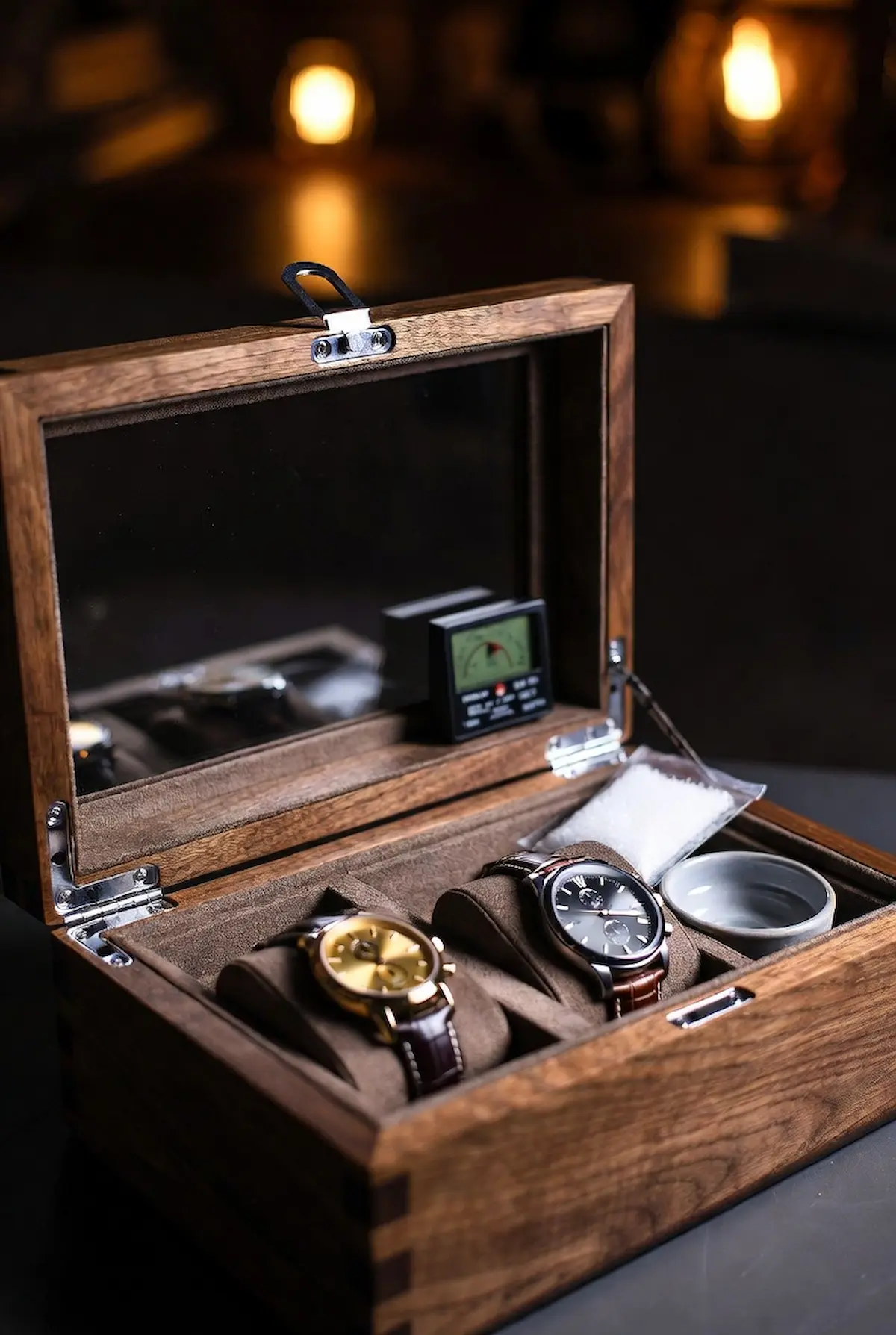
"A proper watch humidity storage box is the difference between a collection that lasts generations and one that develops rust, condensation, and corroded movements within years."
You opened your watch box on a humid summer morning. Your Rolex Submariner had tiny water droplets forming under the crystal.
Your vintage Omega showed a faint rust spot on the crown tube. Your Tag Heuer's bracelet had developed a greenish tinge at the link joints.
None of these watches had been near water. They'd been sitting in your storage box. In your bedroom closet. Doing absolutely nothing.
A collector in Miami showed me his six-watch collection after two years in standard storage. Three watches needed movement servicing due to internal moisture damage. One vintage piece had corroded beyond economical repair. Total cost: $3,800 in preventable damage.
The culprit? Uncontrolled humidity inside sealed watch boxes. Moisture vapor doesn't need liquid water. It just needs warm, still air trapped in an enclosed space.
This guide shows you how to build a DIY watch humidity storage box that maintains safe moisture levels using affordable, readily available materials. You'll learn the exact humidity range your watches need, which absorption methods work best, and how to monitor conditions with precision.
Here's everything you need to know.
Table of Contents
- Editor's Picks: Essential Humidity Control Products
- Why Humidity Destroys Watches Silently
- Building Your DIY Watch Humidity Box: Materials
- Step-by-Step DIY Assembly (15 Minutes)
- Maintaining Your Humidity Box Long-Term
- Advanced Humidity Control Options
- 7 Quick Tips for Watch Humidity Control (Most Collectors Skip These)
- Mistakes That Let Moisture Destroy Watch Collections
- Frequently Asked Questions
- What humidity level is best for watch storage?
- Can humidity damage a waterproof watch?
- How often should I replace silica gel packets?
- Do watch safes control humidity?
- Can I use food-grade desiccant packets for watches?
- Will cedar blocks help control humidity?
- How do I know if my watches have humidity damage?
- Conclusion
This post contains affiliate links. We may earn a small commission at no extra cost to you.
Editor's Picks: Essential Humidity Control Products
Before we dive in, here are the top-rated products most watch collectors trust for humidity management:
- Rechargeable Silica Gel Canister — Reusable, color-indicating, fits inside any watch box
- Digital Hygrometer (Mini) — Precise humidity monitoring, fits in watch boxes
- Boveda Humidity Control Packs (40-50%) — Two-way control, maintains exact humidity range
(More recommendations throughout the article)
Why Humidity Destroys Watches Silently
Most collectors understand water damage. Fewer understand humidity damage — the slow, invisible killer that's far more common.
What Happens Inside a Humid Watch Box
Warm air holds more moisture than cool air. When temperature drops at night, that moisture condenses on the coldest surfaces inside your watch box — which happen to be metal watch cases and bracelets.
This micro-condensation cycle repeats daily. Every morning, tiny water molecules form on metal surfaces. Every afternoon, they evaporate. This daily wet-dry cycle causes:
- Oxidation on steel components (case, crown, pushers)
- Corrosion inside movements (even "waterproof" watches aren't humidity-proof when stored open)
- Tarnishing on gold and gold-plated surfaces
- Mold growth on leather straps
- Degradation of luminous dial material
A collector in Singapore stored his watches in a mahogany box without humidity control. After eighteen months, every watch with a leather strap showed mold at the stitching. Two steel watches had visible corrosion at the crown tube — the tiny gap where moisture enters most easily.
Safe Humidity Range for Watches
Ideal: 40-50% relative humidity
Below 35%: Too dry
- Leather straps crack
- Some gaskets shrink
- Lubricants dry faster 40-50%: Perfect range
- Metal stays corrosion-free
- Leather stays supple
- Gaskets maintain integrity
- Lubricants stay stable Above 60%: Danger zone
- Condensation forms on metal
- Mold develops on leather
- Movement components corrode
- Dial materials degrade
For general watch storage principles beyond humidity, our guide on how to store watches without a watch box covers comprehensive protection strategies.
The next section covers the mistake most people make at this stage.
Building Your DIY Watch Humidity Box: Materials
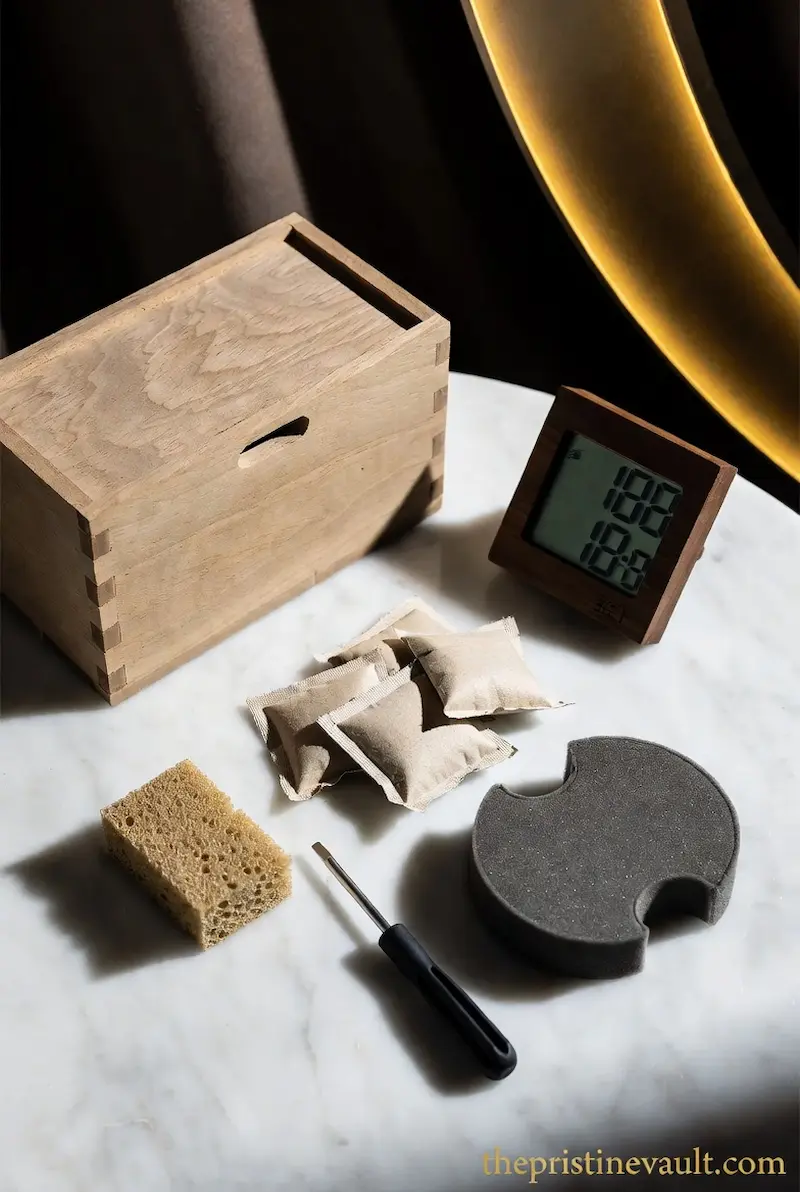
You don't need expensive equipment. Everything required costs under $50 total.
What You Need
The box itself:
Your existing watch box works fine. What matters is adding humidity control to it. However, if your current box has large gaps or doesn't close properly, humidity control becomes impossible.
For collectors shopping for new boxes, look for tight-fitting lids with minimal air gaps. Felt or velvet-lined interiors actually help buffer humidity changes slightly.
Essential supplies:
- Digital hygrometer (mini size) — Must fit inside your watch box
- Silica gel packets or rechargeable canister — Absorbs excess moisture
- Boveda humidity packs (40-50% RH) — Two-way humidity control
- Soft cloth or felt pad — Barrier between humidity products and watches
Optional but recommended:
- Small cedar blocks — Natural moisture absorption plus pleasant scent
- Anti-tarnish strips — Prevents sulfur-based tarnishing on metal
That's it. No special tools. No construction skills. No expensive components.
Up next: the step-by-step assembly that takes 15 minutes.
Step-by-Step DIY Assembly (15 Minutes)
Building your humidity-controlled watch box requires six simple steps.
Step 1: Clean Your Watch Box Thoroughly
Remove all watches and cushions. Vacuum the interior to remove dust and debris. Wipe interior surfaces with a barely damp cloth. Let dry completely — at least 2 hours.
Why this matters: Dust and debris trap moisture. Starting clean means your humidity control products work on ambient moisture only, not on water trapped in accumulated grime.
Step 2: Place the Digital Hygrometer
Position your mini hygrometer where you can read it without removing watches. Most collectors place it in a corner or along the back wall of the box.
Some hygrometers have adhesive backs that stick to box walls. Others sit freely. Either works as long as you can see the reading when you open the box.
👉 Get Mini Digital Hygrometer on Amazon
Step 3: Add Silica Gel Protection
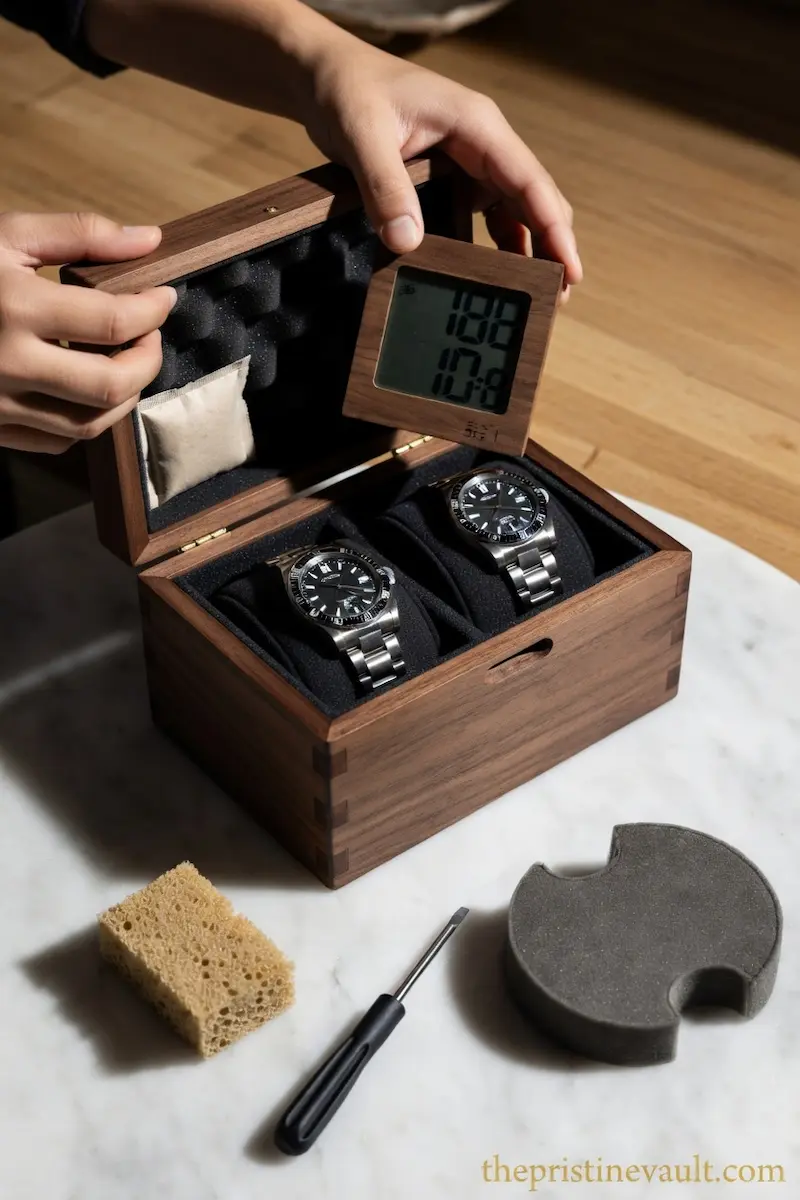
For packets: Place 2-3 silica gel packets between watch cushions. Wrap each packet in a thin cloth to prevent direct contact with watches or straps.
For rechargeable canisters: Place one canister in the box. These are larger than packets but last months before needing recharging.
Position silica gel away from direct contact with leather straps. While silica gel doesn't damage leather, placing it directly against leather can create dry spots over extended periods.
Step 4: Add Boveda Packs (Optional but Recommended)
Boveda packs are two-way humidity controllers. Unlike silica gel (which only absorbs), Boveda both absorbs AND releases moisture to maintain a specific humidity range.
Place 1-2 Boveda 49% RH packs inside the box. These maintain humidity at exactly 49% — right in the middle of the safe range for watches.
Boveda packs last 2-4 months depending on conditions. When they feel crunchy/hard instead of soft, replace them.
👉 Check Boveda 49% Humidity Packs on Amazon
Step 5: Replace Watch Cushions and Watches
Place cushions back. Return watches to their positions. Close the box.
Avoid opening the box more than necessary for the first 24 hours. Let the humidity control products stabilize the internal environment.
Step 6: Record Baseline Humidity Reading
After 24 hours, open the box and check the hygrometer reading. This is your baseline.
- 40-50%: Perfect. Your setup is working.
- Above 55%: Add another silica gel packet or Boveda pack.
- Below 35%: Remove one silica gel packet. Your environment may be too dry already.
Record this reading and check weekly going forward.
For collectors using watch winders alongside humidity-controlled storage, proper winder settings protect movements from mechanical stress. Our guide on Rolex watch winder settings covers exact TPD and direction specifications.
But building the box is only half the battle — here's what ongoing maintenance requires.
Maintaining Your Humidity Box Long-Term
Set-and-forget doesn't work with humidity control. Regular maintenance keeps protection active.
Weekly Check (30 Seconds)
Open the box. Read the hygrometer. If humidity is within 40-50%, close the box. Done.
That's all weekly maintenance requires. Thirty seconds of looking at a number.
If humidity drifts above 55% consistently, add another silica gel packet. If it drops below 35% consistently, remove a packet.
Monthly Maintenance (5 Minutes)
Once monthly, remove all watches. Inspect each watch for any signs of moisture damage: condensation under crystals, tarnishing, strap deterioration.
Check silica gel packets — color-indicating types show blue/orange when active and pink/clear when saturated. Replace saturated packets.
Inspect Boveda packs. Squeeze gently. If they're still soft and pliable, they're working. If they feel hard or crunchy, replace them.
Vacuum the box interior lightly. Dust accumulation reduces humidity control effectiveness.
Seasonal Adjustments
Summer (hot and humid): You may need additional silica gel. Monitor more frequently — weekly checks become essential.
Winter (cold and dry): Central heating creates dry environments. You may need to reduce silica gel or rely primarily on Boveda packs for two-way control.
Monsoon/rainy season: Maximum humidity challenge. Consider adding a dedicated mini dehumidifier near (not inside) your watch storage area.
For collectors with Rolex Datejust models requiring both winder storage and humidity control, our guide on best watch winders for Rolex Datejust covers compatible options with integrated humidity management.
The next section covers the mistake most people make at this stage.
Advanced Humidity Control Options
When DIY basics aren't enough, these upgrades provide premium protection.
Electronic Humidity Controllers
For large collections (10+ watches) or extremely humid climates, electronic humidity controllers maintain precise ranges automatically.
These small devices contain sensors that activate tiny fans or dehumidifying elements when humidity exceeds set thresholds. Some models connect to smartphone apps for remote monitoring.
Typical cost: $40-80. Worth considering if your collection value exceeds $25,000.
Dry Cabinets
Purpose-built dry cabinets used by photographers for camera equipment work excellently for watch collections. They maintain exact humidity levels automatically and offer substantial capacity.
These represent the premium solution — $150-400 depending on size. But for serious collectors in tropical climates, they eliminate humidity concerns entirely.
Pelican-Style Cases with Foam
Waterproof cases designed for camera equipment or military applications provide airtight seals that keep humidity out completely.
Custom-cut foam inserts accommodate individual watches. Combined with humidity control packets inside the sealed case, this creates near-perfect storage conditions.
👉 Check Waterproof Storage Cases on Amazon
7 Quick Tips for Watch Humidity Control (Most Collectors Skip These)
Never store watches in bathrooms. Humidity from showers creates the worst possible storage environment, even in enclosed boxes.
Keep watch boxes off floors. Ground level has higher humidity than elevated surfaces. Store on shelves or dressers minimum 3 feet off ground.
Avoid exterior walls for storage. Temperature differences between inside and outside walls create condensation zones.
Don't store watches in safes without humidity control. Home safes are sealed environments where humidity fluctuates wildly and condenses on cool metal surfaces.
Remove leather straps from watches during long-term storage. Store straps separately to prevent mold growth from transferring to watch components.
Rotate watch positions in the box quarterly. Different positions within the box experience slightly different micro-climates.
Replace all humidity control products on a fixed schedule. Don't wait for failure — replace silica gel every 3-6 months and Boveda packs every 2-4 months regardless of apparent condition.
⚠️ Pro Tip: Buy indicating silica gel that changes color when saturated. Standard white silica gel gives no visual warning before it stops working. Color-indicating gel shows orange when active and green when exhausted — eliminating guesswork from replacement timing.
👉 Get Color-Indicating Silica Gel on Amazon
Mistakes That Let Moisture Destroy Watch Collections
These common errors compromise humidity protection:
Storing watches in original brand boxes inside a watch box. Double-boxing traps moisture between layers. Original boxes aren't sealed — they allow moisture in but prevent controlled air exchange. Remove watches from presentation boxes before placing in humidity-controlled storage.
Using regular rice instead of silica gel. Rice absorbs minimal moisture and introduces dust particles that scratch watch surfaces. It also attracts insects. Always use purpose-made desiccants.
Sealing watch boxes completely airtight without humidity control. Airtight + no desiccant = trapped moisture that condenses repeatedly. Watches need either controlled humidity inside sealed environments or moderate air circulation in unsealed storage.
Ignoring the hygrometer after initial setup. Conditions change with seasons, weather, and home HVAC usage. A hygrometer reading from January is meaningless in July. Monitor consistently.
Placing silica gel directly against watch surfaces. Direct contact between desiccant packets and metal or leather can create localized dry zones that damage gaskets or crack leather. Always maintain a cloth barrier.
Frequently Asked Questions
What humidity level is best for watch storage?
Maintain 40-50% relative humidity. Below 35% causes leather cracking, gasket shrinkage, and accelerated lubricant drying. Above 60% promotes condensation, corrosion, and mold growth. The 40-50% range protects all materials simultaneously.
Can humidity damage a waterproof watch?
Yes. "Waterproof" watches resist liquid water intrusion during submersion. Humidity operates differently — water vapor molecules are smaller than liquid water molecules and can penetrate gaskets over extended exposure. Additionally, watches stored open (off wrist, crown not screwed down) have reduced moisture resistance.
How often should I replace silica gel packets?
Standard packets: every 3-6 months depending on ambient humidity. Rechargeable canisters: recharge when color indicator changes (typically every 4-8 weeks in humid climates).
Boveda packs: every 2-4 months or when they feel hard and crunchy. For alternative storage methods without humidity control products, our guide on how to store watches without a watch box covers everyday solutions.
Do watch safes control humidity?
Most home safes don't. Standard safes are designed for fire and theft protection, not climate control. The sealed environment actually makes humidity problems worse by trapping moisture inside.
If using a safe, add humidity control products inside and monitor with a hygrometer.
Can I use food-grade desiccant packets for watches?
Yes, food-grade silica gel is chemically identical to specialty desiccant. The small packets from shoe boxes and food packaging work perfectly. However, purpose-made watch storage desiccants offer better capacity and color indication — worth the small upgrade for valuable collections.
Will cedar blocks help control humidity?
Cedar absorbs modest amounts of moisture and provides natural antimicrobial properties that prevent mold. However, cedar alone can't maintain specific humidity ranges. Use cedar as a supplement to silica gel or Boveda packs, not as a replacement.
How do I know if my watches have humidity damage?
Early signs include: condensation under crystal (fog that appears and disappears), tarnishing on case or bracelet, musty smell from leather straps, intermittent timekeeping issues (moisture affecting movement), and visible corrosion on crown or pushers. Any of these warrant immediate professional inspection.
Conclusion
Building a DIY watch humidity storage box takes 15 minutes and costs under $50. The protection it provides saves thousands in moisture damage over your collection's lifetime.
Three elements make the system work: a quality hygrometer for monitoring, silica gel or Boveda packs for moisture control, and consistent weekly monitoring to catch problems before they cause damage.
Humidity damage is entirely preventable. Every corroded movement, every moldy strap, every condensation-fogged crystal represents a failure of storage conditions — not a failure of the watch itself.
Start with the basics — a mini hygrometer and a few silica gel packets. Upgrade to Boveda packs and electronic controllers as your collection grows and your climate demands.
Now it's your turn — check the humidity inside your current watch storage this week and add protection where readings exceed safe ranges. Your luxury watches will thank you for it.